

For enablement teams that want partners to work through training in a fixed order, without enrolling anyone by hand at each step.A catalog of courses leaves partners to guess where to start and which course comes next. A sequence fixes that: each partner sees only the course they are ready for, and the next one appears when they finish. Introw has no “course order” setting, so you build the sequence from two things you already have: dynamic segments and auto-enrollment.
What you’ll achieve
A curriculum of two or more levels, for example Introduction, Basic training, and Advanced training. New partner contacts enter at level 1, and each contact moves up on their own as they complete a course. Nobody is enrolled by hand.How the sequence works
Courses enroll partners through segments, and dynamic segments update as contacts change. That lets you define each level by what the contact has already completed:
When a contact finishes a course, they match the next segment and are enrolled in the next course.
Add as many levels as you need with the same pattern.
Before you start
1
Confirm access
You need a team role with write access to Courses and access to segment settings.
2
Plan your levels
Decide the order of your courses and who should start at level 1.
Build each level as its own course, not as modules inside one course.
Modules run inside a single course, but only separate courses can unlock one another.
Watch it
- Video
- Click through
Steps
Create the courses
1
Build one course per level
Go to Courses and create each course on its own, by building it manually, generating it with AI, or importing a SCORM course.
Give the courses names you can tell apart in a dropdown, because you pick them by name when you build the segments.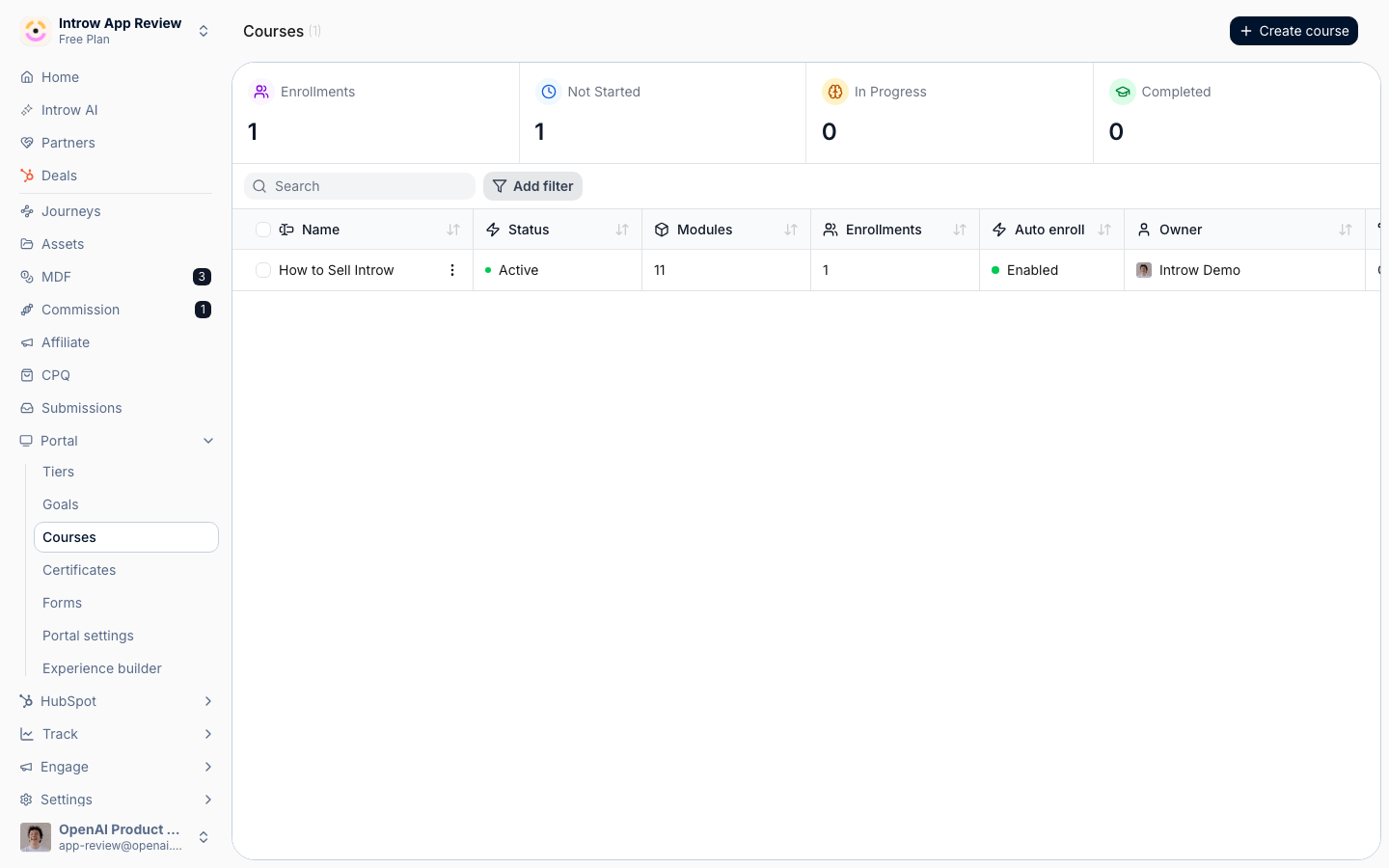
Create one segment per level
1
Create the level 1 segment
Go to Segments and create a partner contact segment with Dynamic enrollment.
Set the entry criteria for your first course, for example Phase is Onboarding, or a contact role such as Sales rep.
This segment decides who starts the curriculum.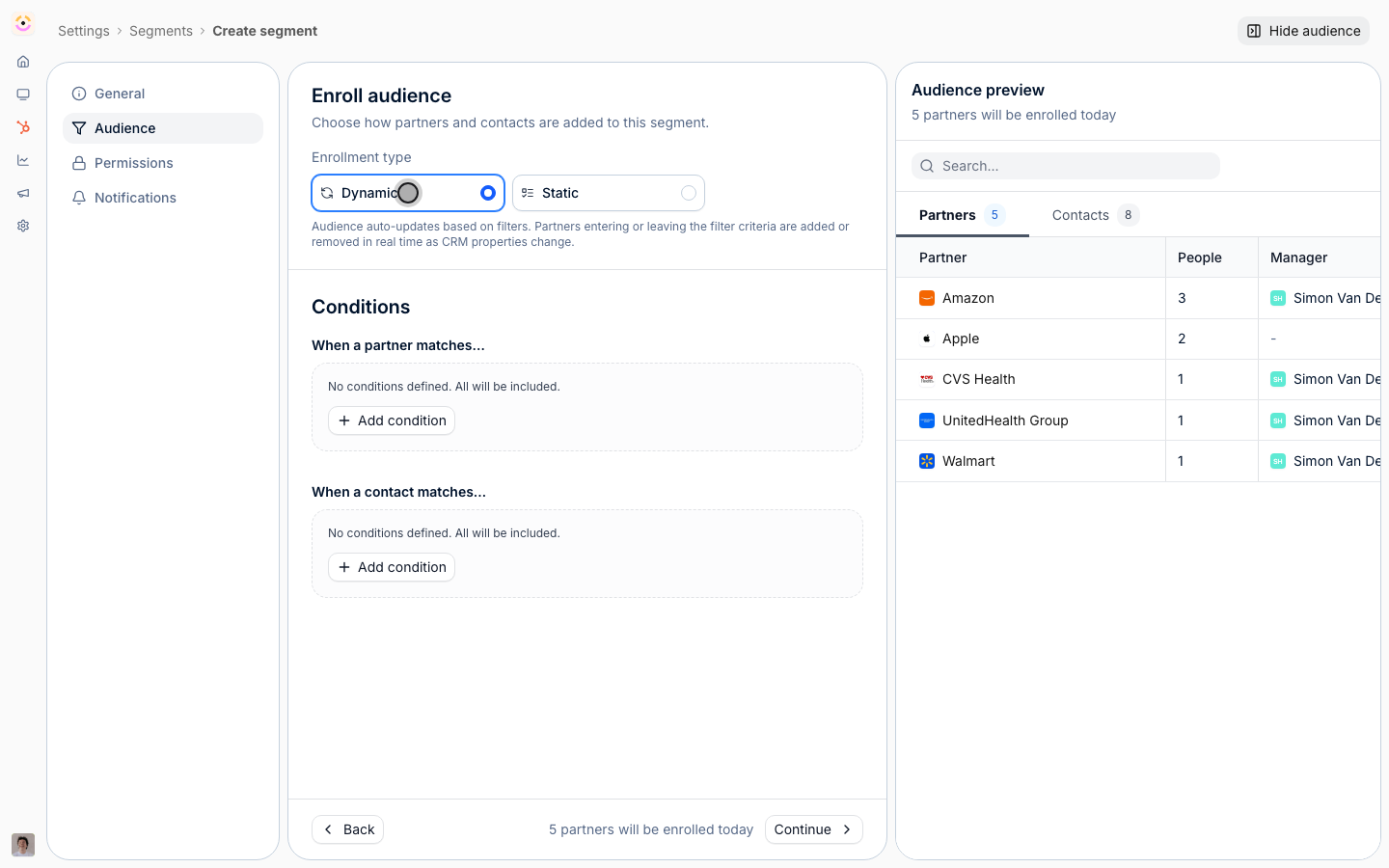
2
Create the level 2 segment
Create a second dynamic segment with the condition Completed course is your level 1 course.
Contacts join it as soon as they complete that course.
3
Create the level 3 segment, and any further levels
Repeat for each level: Completed course is the course from the level before.
Check the audience preview on each segment to confirm it matches who you expect.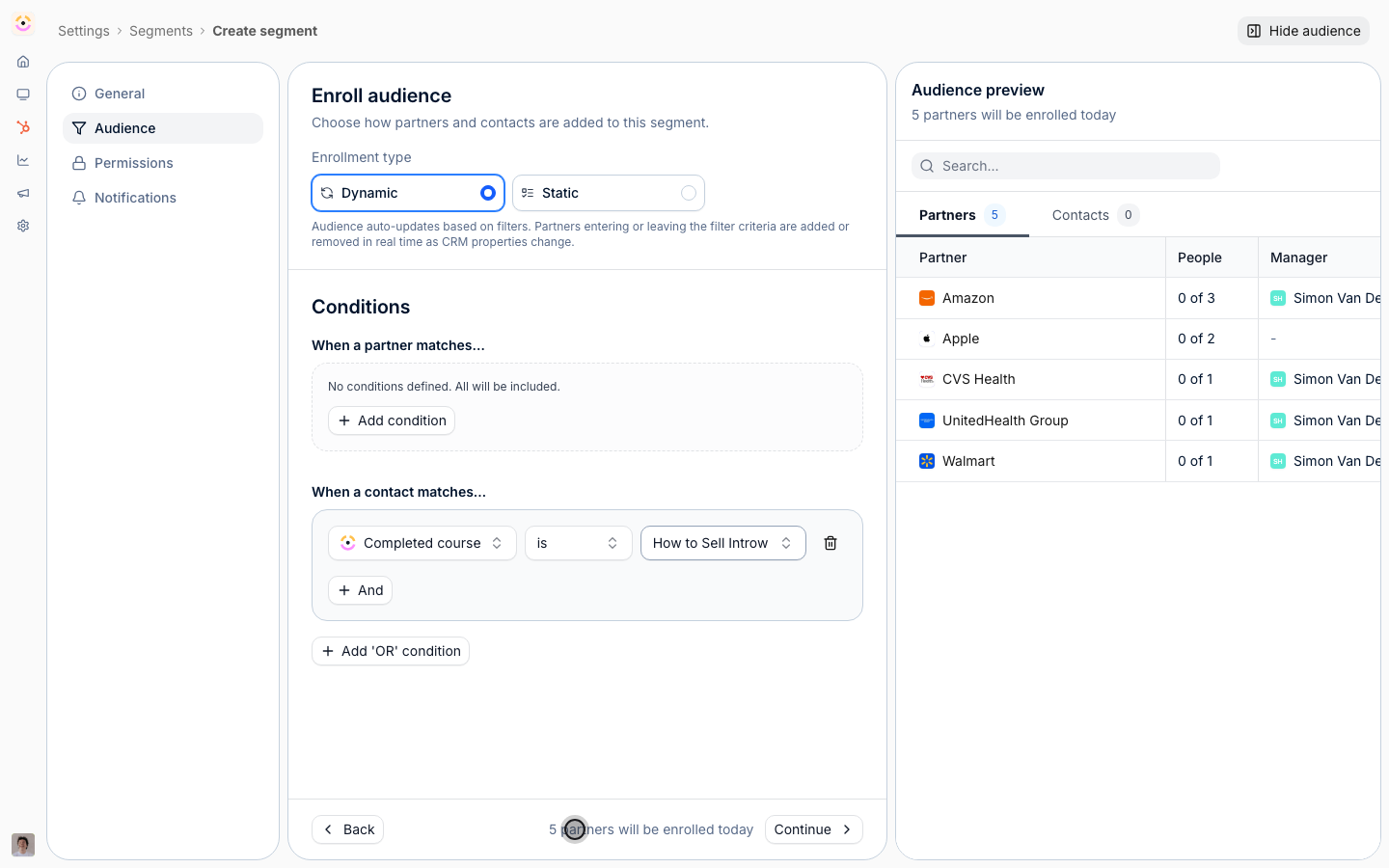
If a segment should only include contacts who are also in your target group, add that entry criterion to the level 2 and 3 segments too.
Without it, a contact outside your target group who completes level 1 still moves up.
Assign each segment to its course
1
Open the course settings
Open a course from Courses, select Configure, and go to the Enrollment tab.
2
Turn on auto-enrollment and pick the level's segment
Turn on Enable automatic enrollment, then select the segment for that level.
Save your changes.
Repeat for every course in the sequence.
See Configure enrollment rules for the full set of options, including due dates.
Verify it worked
Open each course and check its Enrolled tab. The level 1 course lists the contacts in your entry segment, and the later courses start empty. When a contact completes level 1, they appear on the level 2 course’s Enrolled tab. In the partner portal, a contact sees only the course they are ready for, so the path reads as a guided sequence and not a catalog.Tips
- Attach a certificate to each course. Partners get recognition at every step, and you can issue a certificate to a segment.
- Add due dates. A relative due date on each course keeps partners moving through the levels.
- Nudge stalled learners. Use nudges on the course a contact is stuck on.
- Reuse the segments. The same level segments can unlock portal tabs, asset folders, or deal registration, so completing training can open up access as well as the next course.
- Auto-enrollment only adds people. A contact who leaves a segment stays enrolled in the course they already have.
Related
Configure enrollment rules
Auto-enroll segments and set completion deadlines.
Create a dynamic segment
Build the segments each level depends on.
Monitor course progress
See where each partner is in the curriculum.
Implementation reference
Auto-enrollment, reach previews, and due dates.