

What you’ll achieve
A fund whose request, claim, ROI, and invoice steps are configured with clear deadlines, plus a repeatable operating flow where every partner request is reviewed with a recorded decision, claims are checked against approved budget with proof attached, and reimbursed requests are marked paid so their status syncs to the CRM and the program stays auditable.Before you start
Have a fund in place
Create the fund first, including its budget and currency. See Set up an MDF program.
Confirm write access to MDF and forms
You need write access to MDF to configure the lifecycle and decide submissions, and to forms if you adjust the lifecycle forms.
Let partners reach the request form
Partners need a way to submit requests, in the portal or by a shared link. See Request funds by link.
Watch it
- Video
- Click through
Steps
Configure the lifecycle steps
Open the fund in Configure mode
Go to Marketing Funds, open the fund, and use Configure to enter edit mode. The left navigation lists the four lifecycle steps as tabs: Request Fund, Claims, ROI, and Invoices.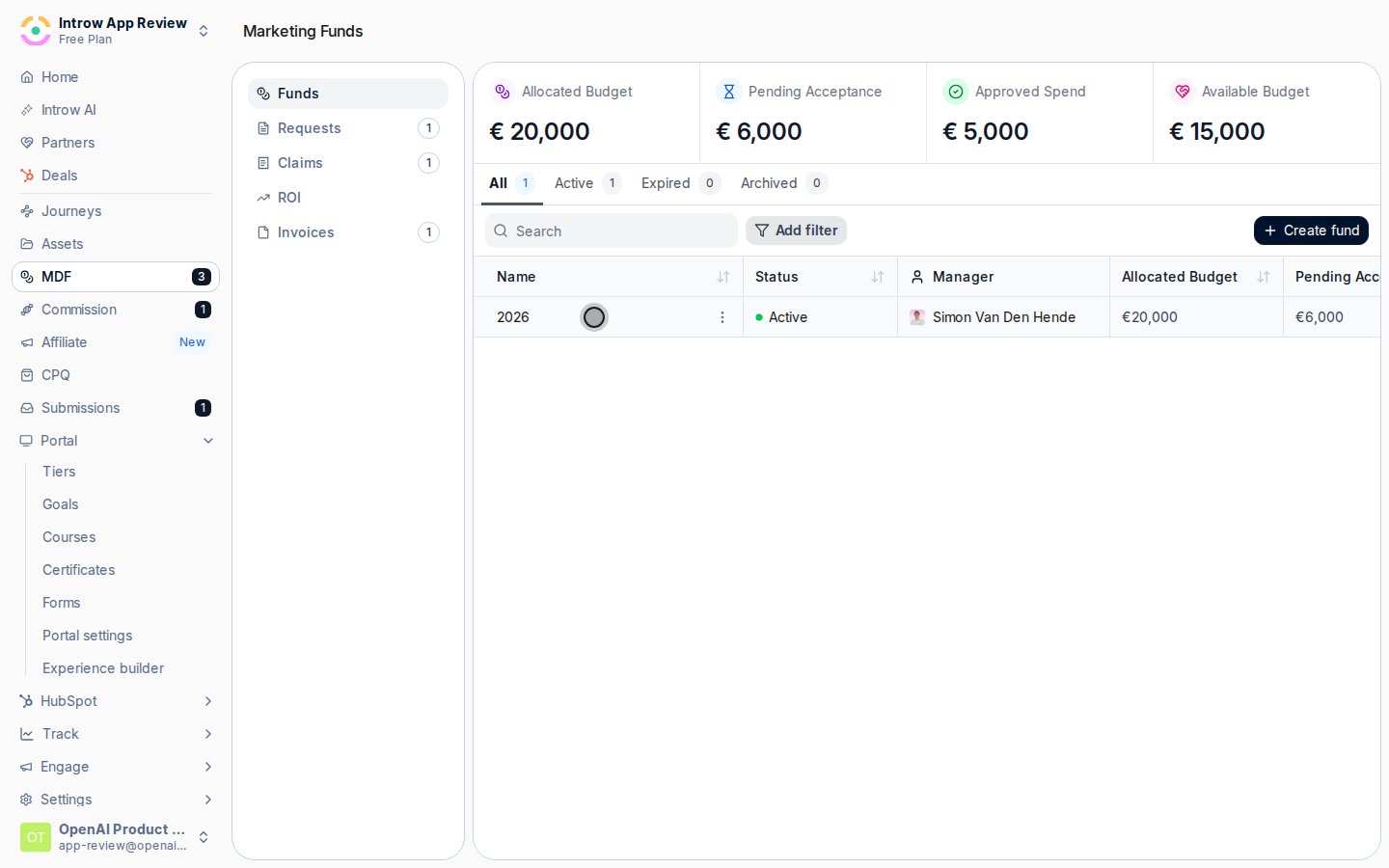
Confirm the form on each step
On each tab, the Intake form section shows the form partners complete for that step, already provisioned with the fund. Use Go to form if you need to change fields, layout, or who approves; otherwise leave the default in place. The request step captures the activity plan and budget ask, the claim step captures proof of spend, the ROI step captures outcomes, and the invoice step captures billing details for payout.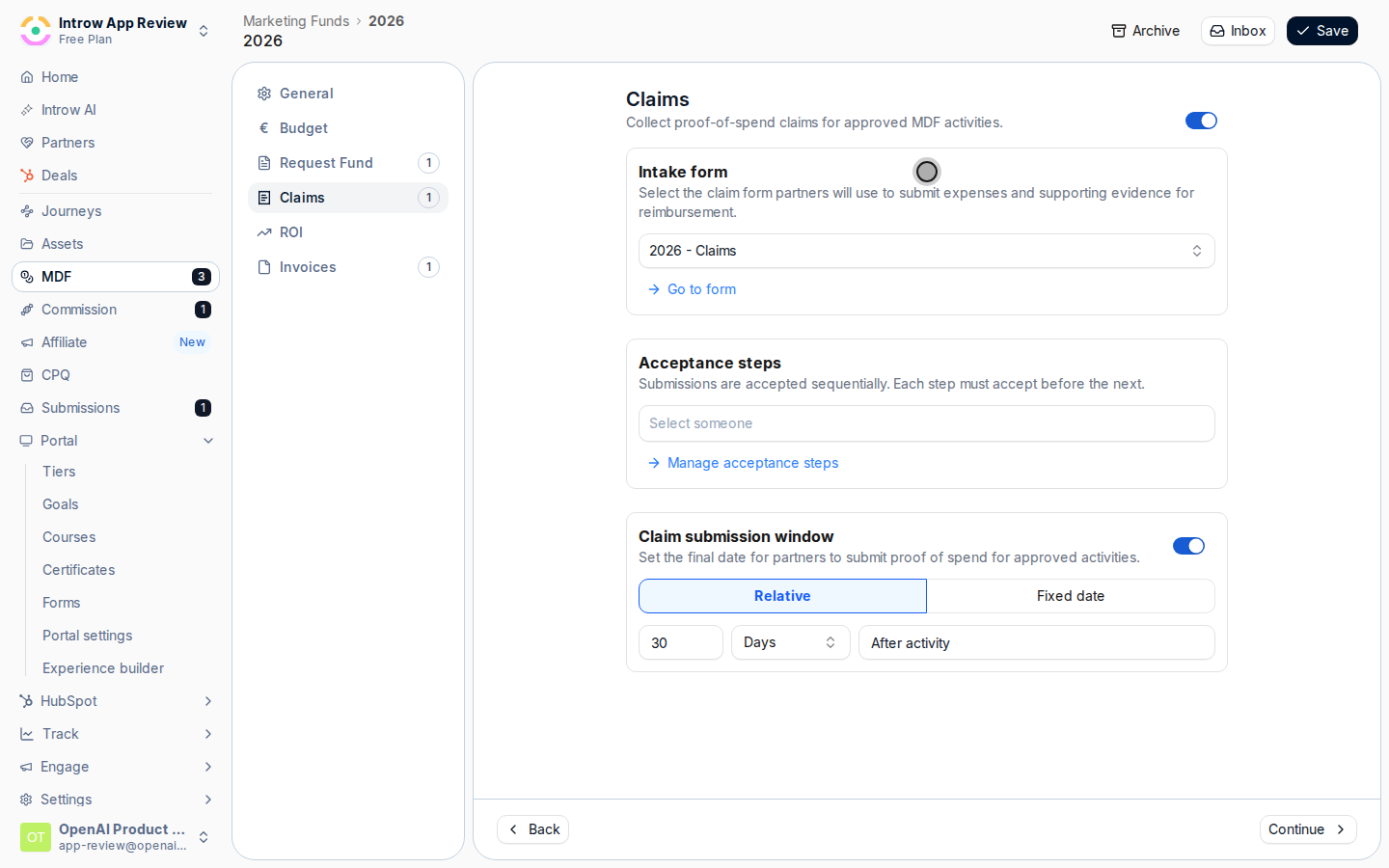
Enable only the steps you use
The Claims, ROI, and Invoices tabs each have a switch at the top to turn the step off. Disable any step your program does not need, so partners are never asked for something you will not act on. The request step is always part of the flow.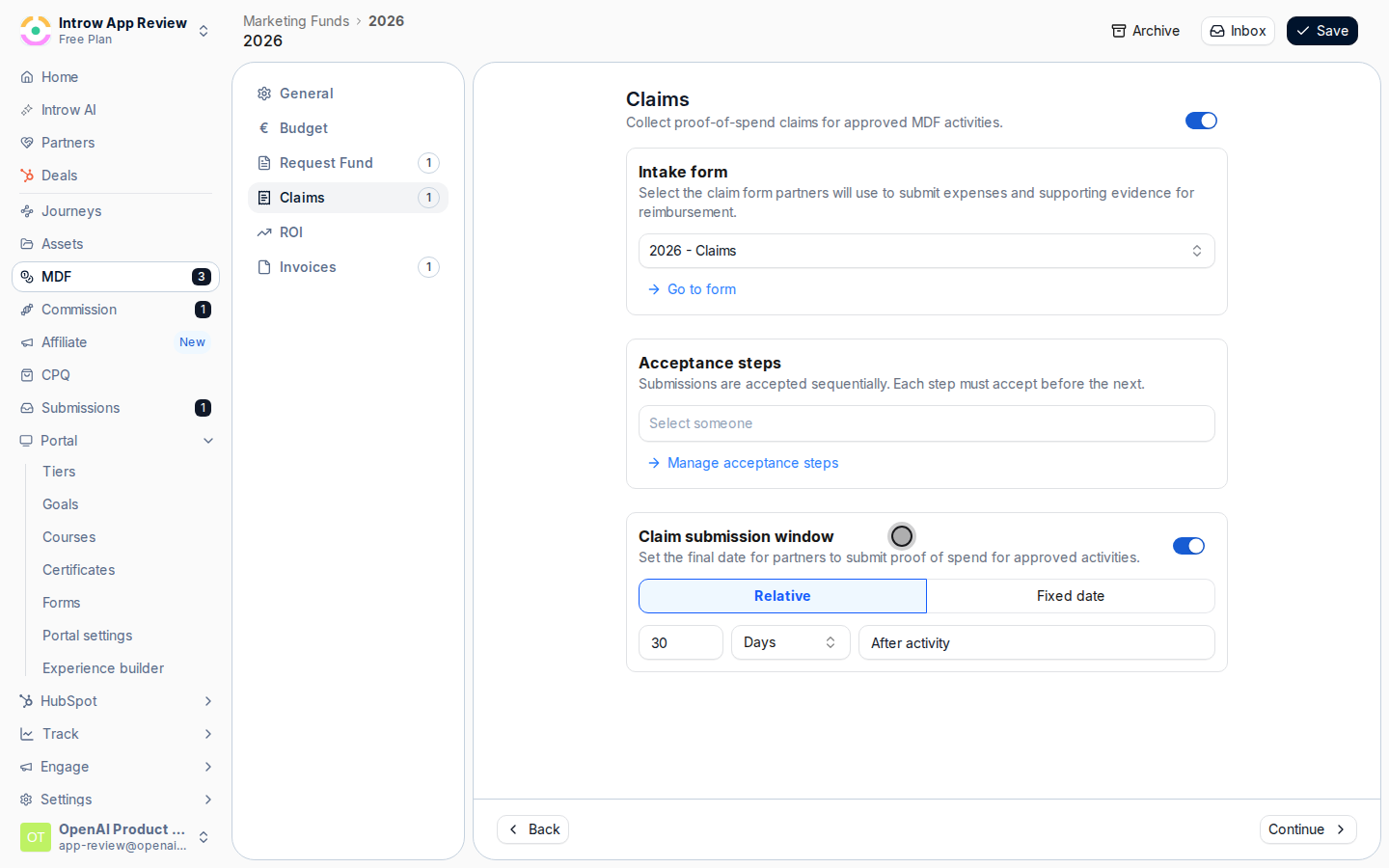
Set the deadline on each step
Each tab has a timeline you can enable so expectations are explicit: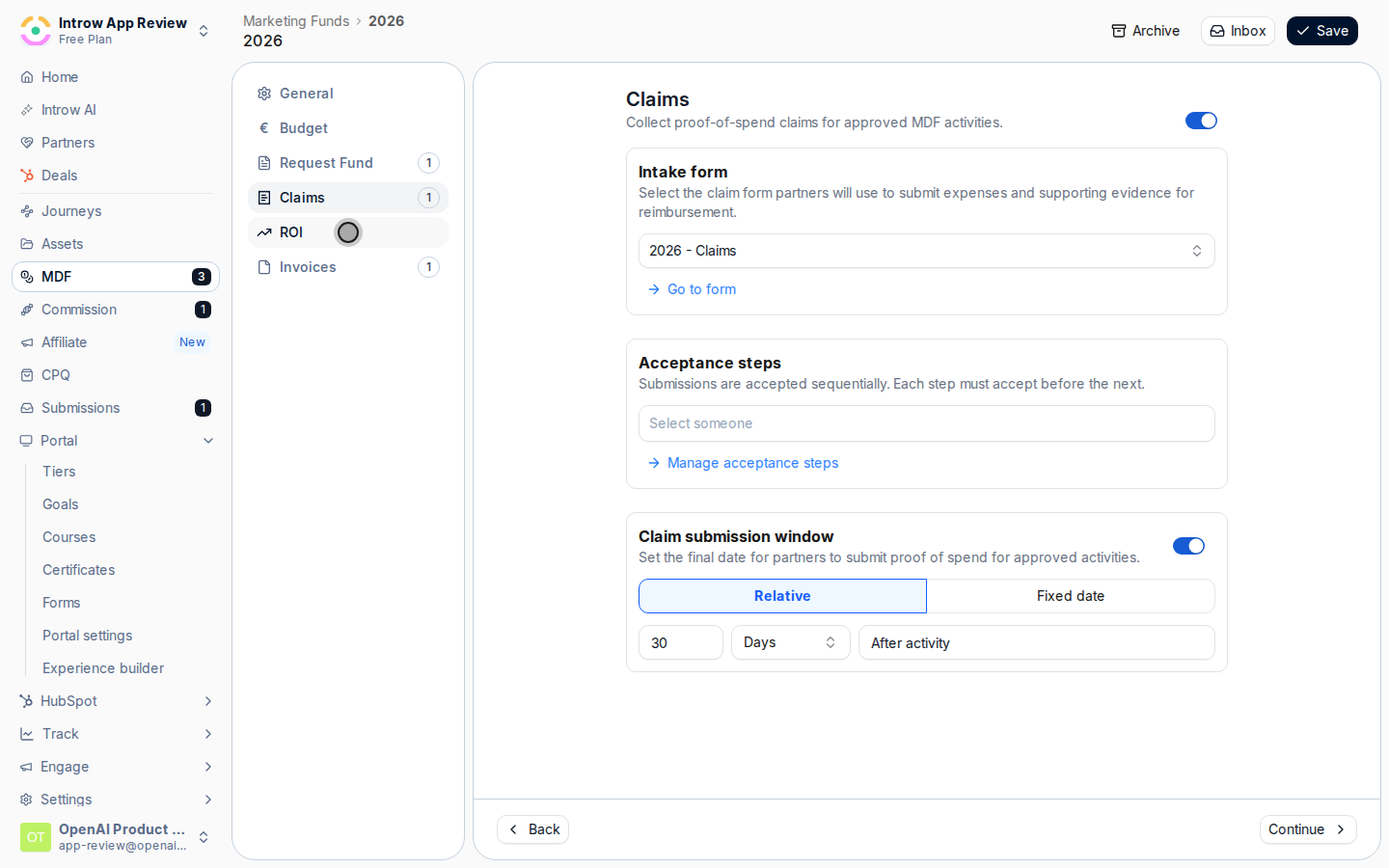
- Request decision timeline - your team’s SLA to decide a request, measured from when it is submitted.
- Claim submission window - how long partners have to submit proof of spend, measured from the activity date.
- ROI reporting window - when partners must report outcomes, measured from the activity date.
- Invoice reimbursement deadline - the last date to submit an invoice for payout, measured from the activity date.
Review and decide a request
Open incoming requests
On Marketing Funds, open the Requests tab for every fund, or open the fund and use Inbox to see just its requests. The status sub-tabs (All, Pending, Accepted, Declined) let you focus on what still needs a decision. You can also work requests from the central Submissions inbox.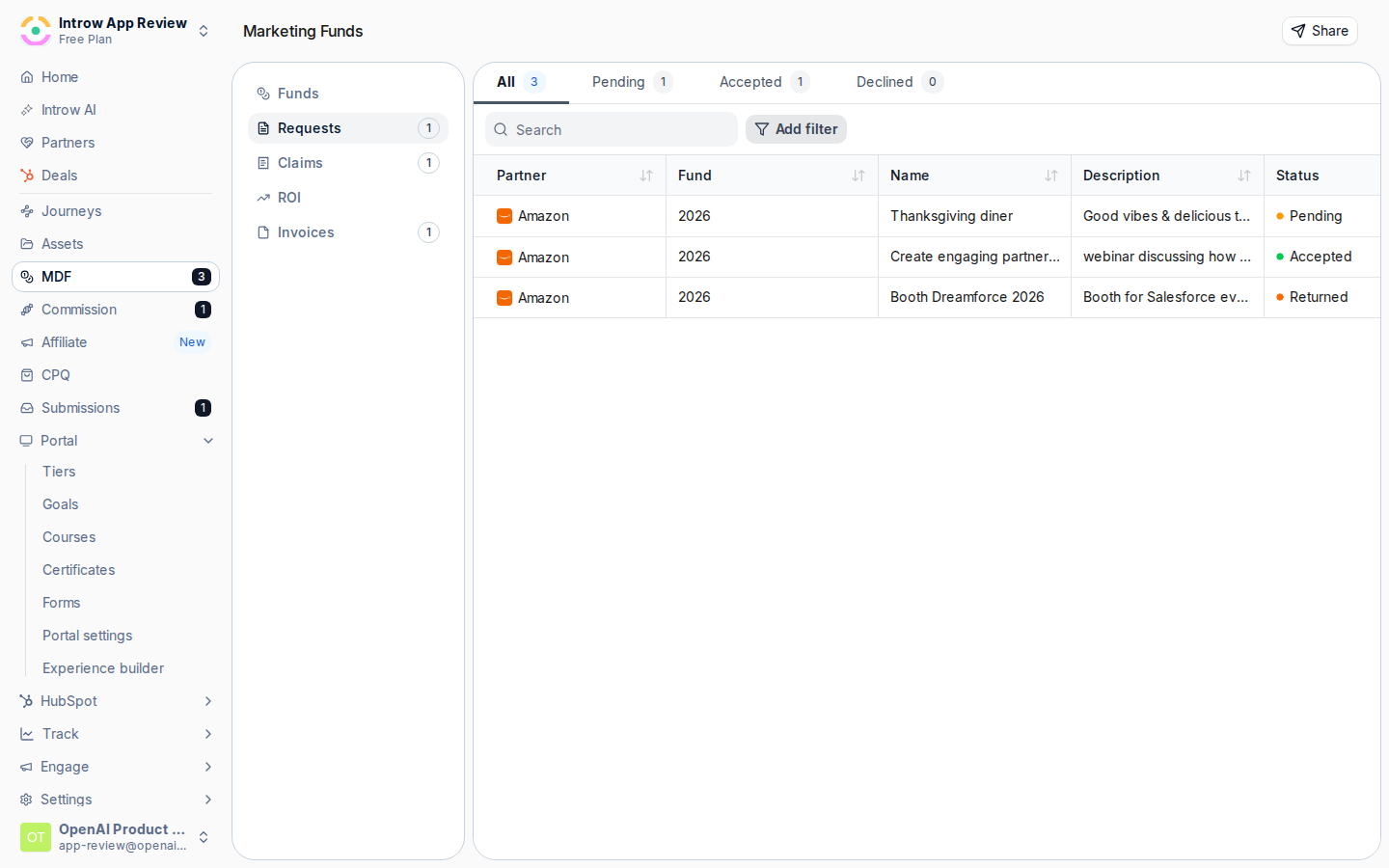
Review the details
Open a pending request and check what you are funding: the requested amount against the fund’s available budget, the planned activity, and the expected outcomes. This is where you decide whether the spend is worth the budget it draws down.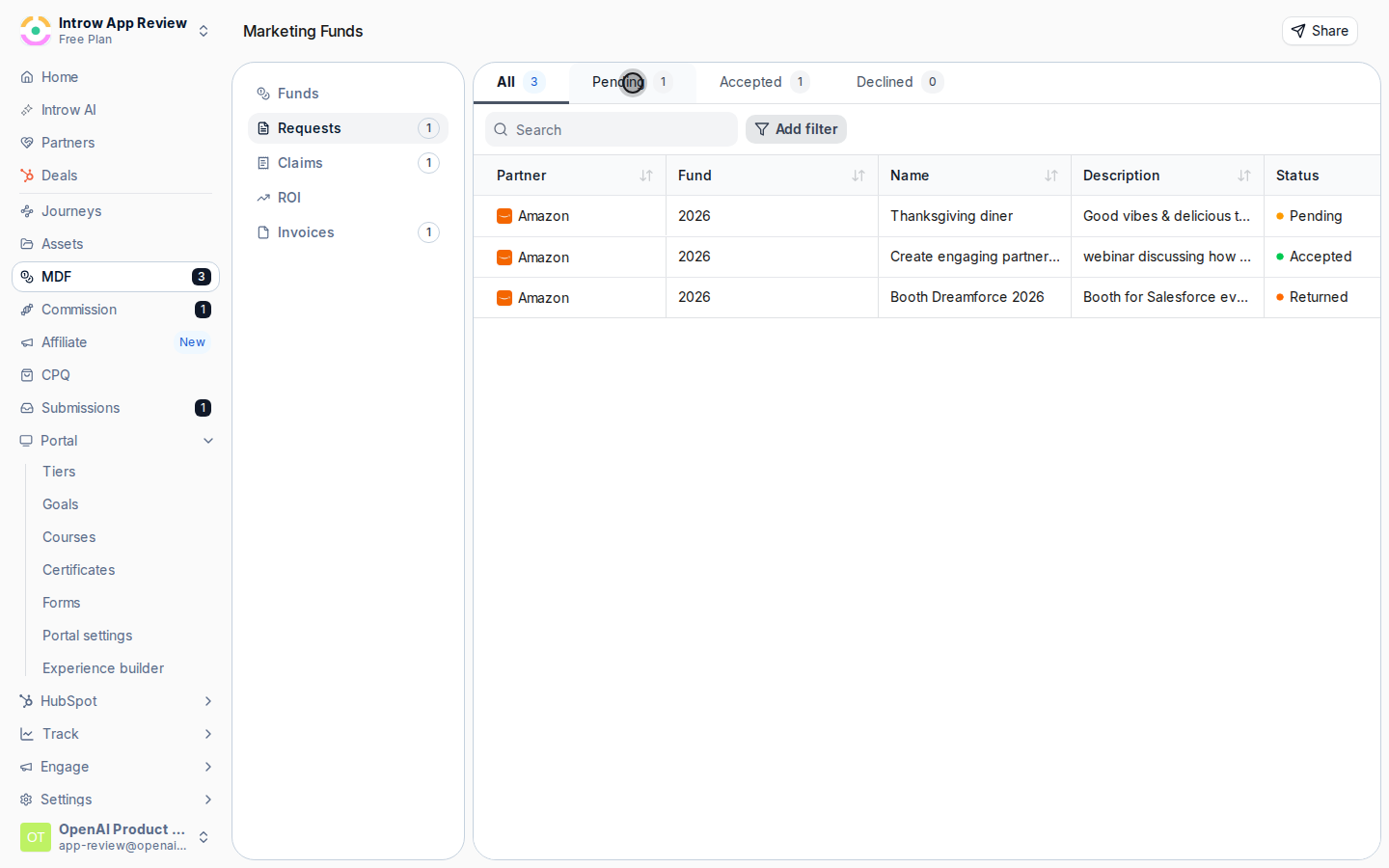
Accept, decline, or return it
Give the request a decision using the standard submission actions: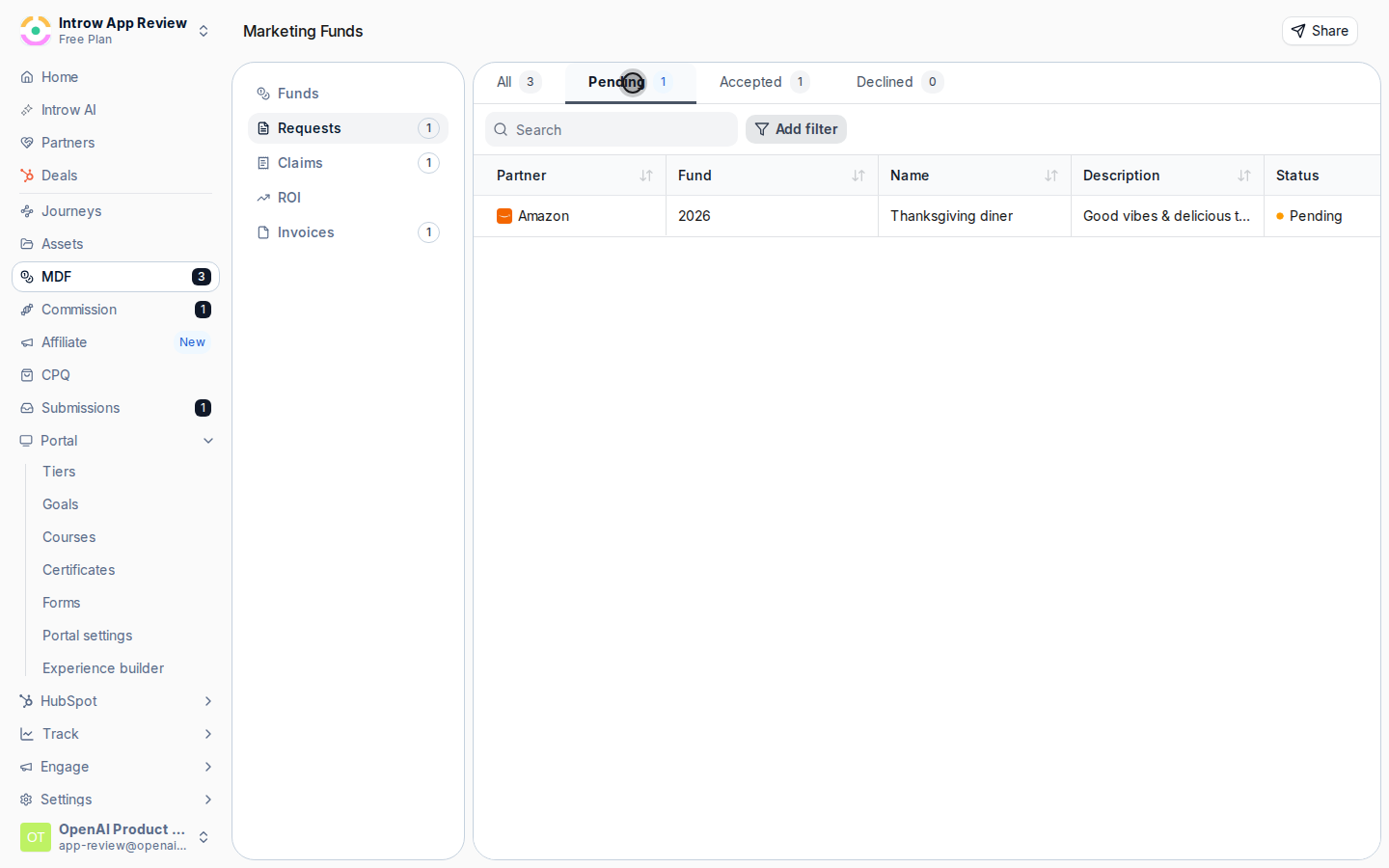
- Accept - approve the request so the partner can proceed and later claim against it.
- Decline - reject the request when it should not be funded.
- Return - send it back for more information when the plan or amount is unclear, so the partner can revise and resubmit.
Collect claims and proof
Make sure partners can claim
Once a request is approved, the partner submits the claim form to prove spend, in the portal or via a shared link. Claims are accepted only while the claim window is open, so confirm the window covers the activity.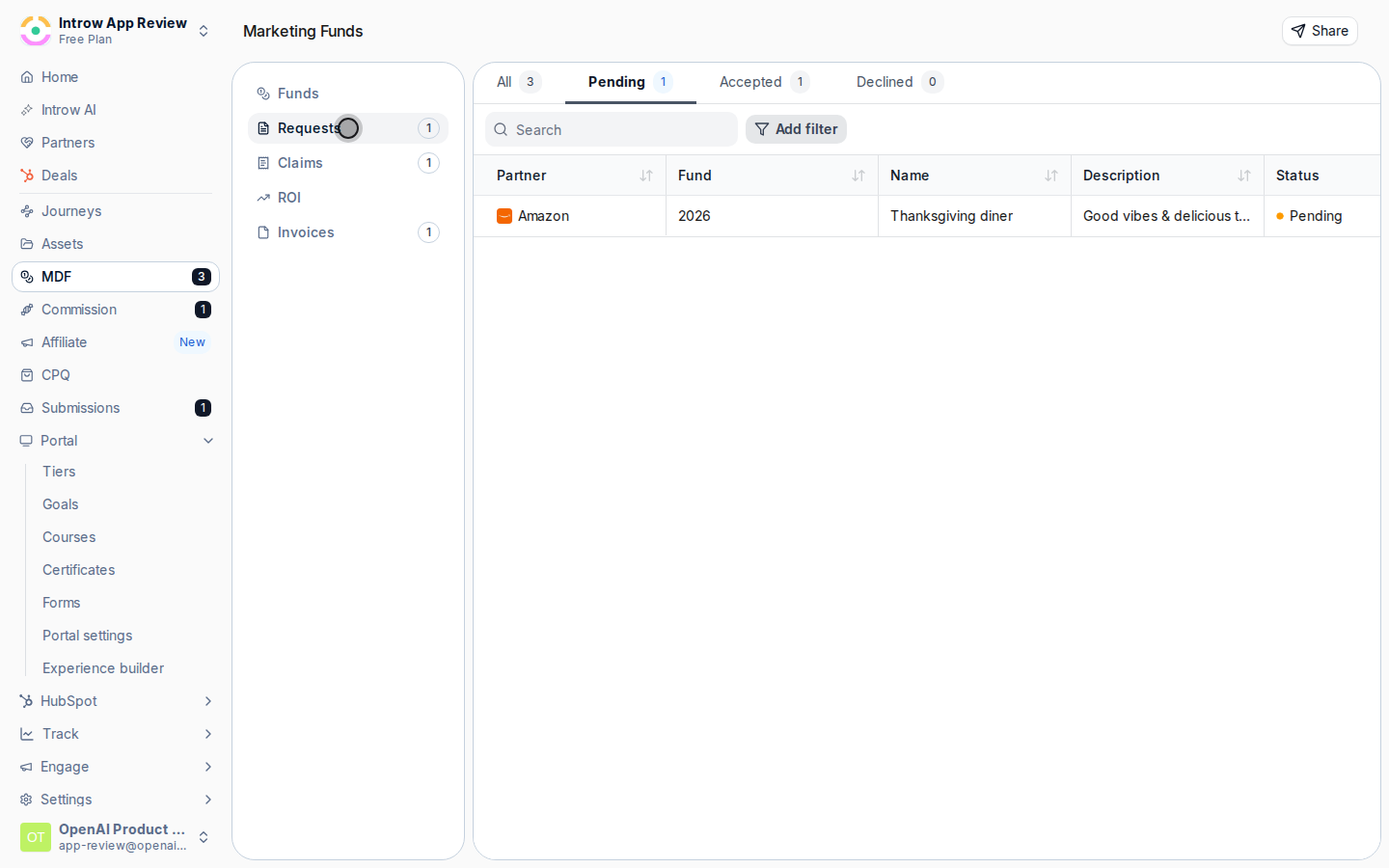
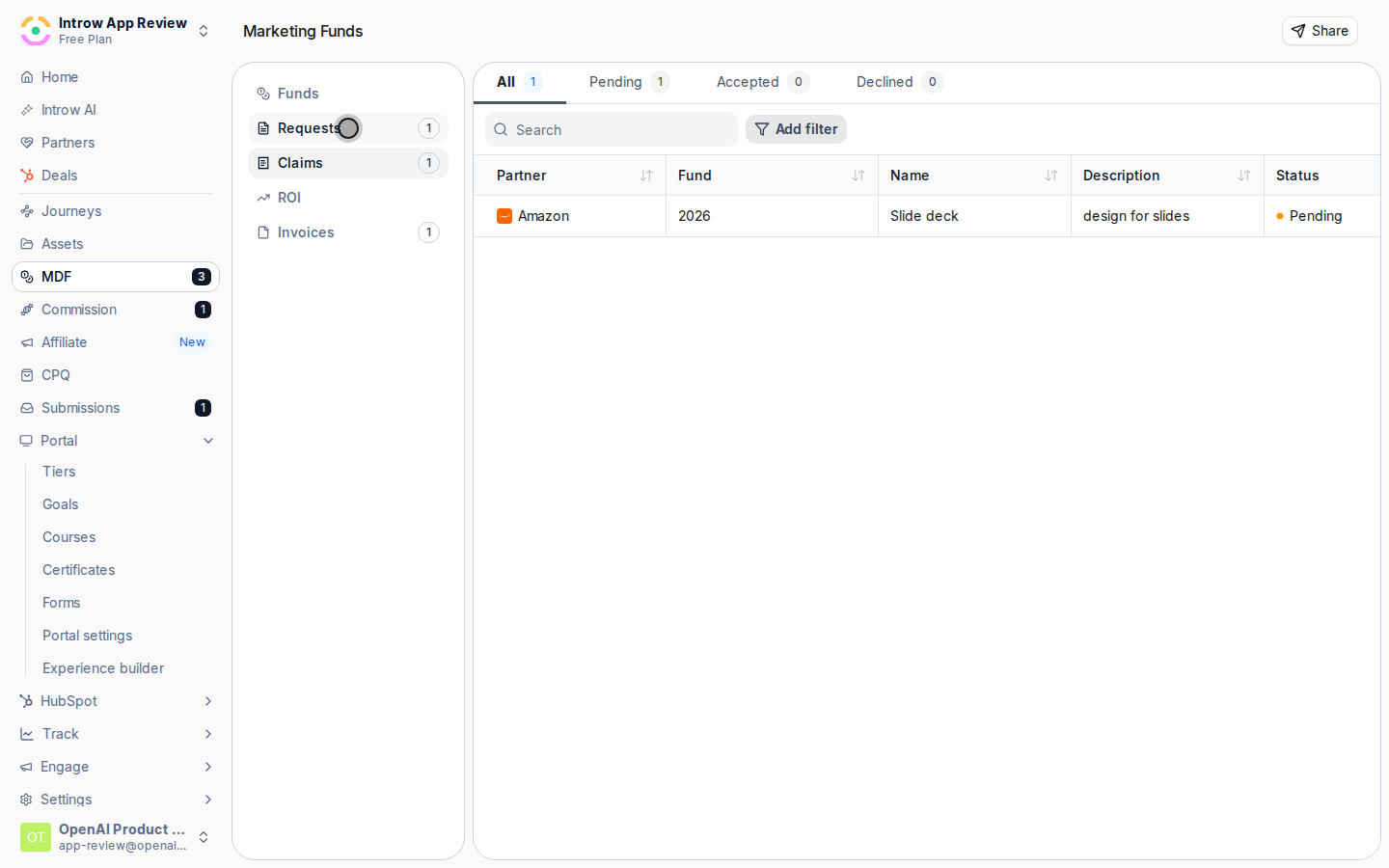
Receive and open claims
Claims arrive on the fund’s Claims tab and in the central Submissions inbox. Open each claim to see the amount claimed against the approved budget and the attached proof of spend.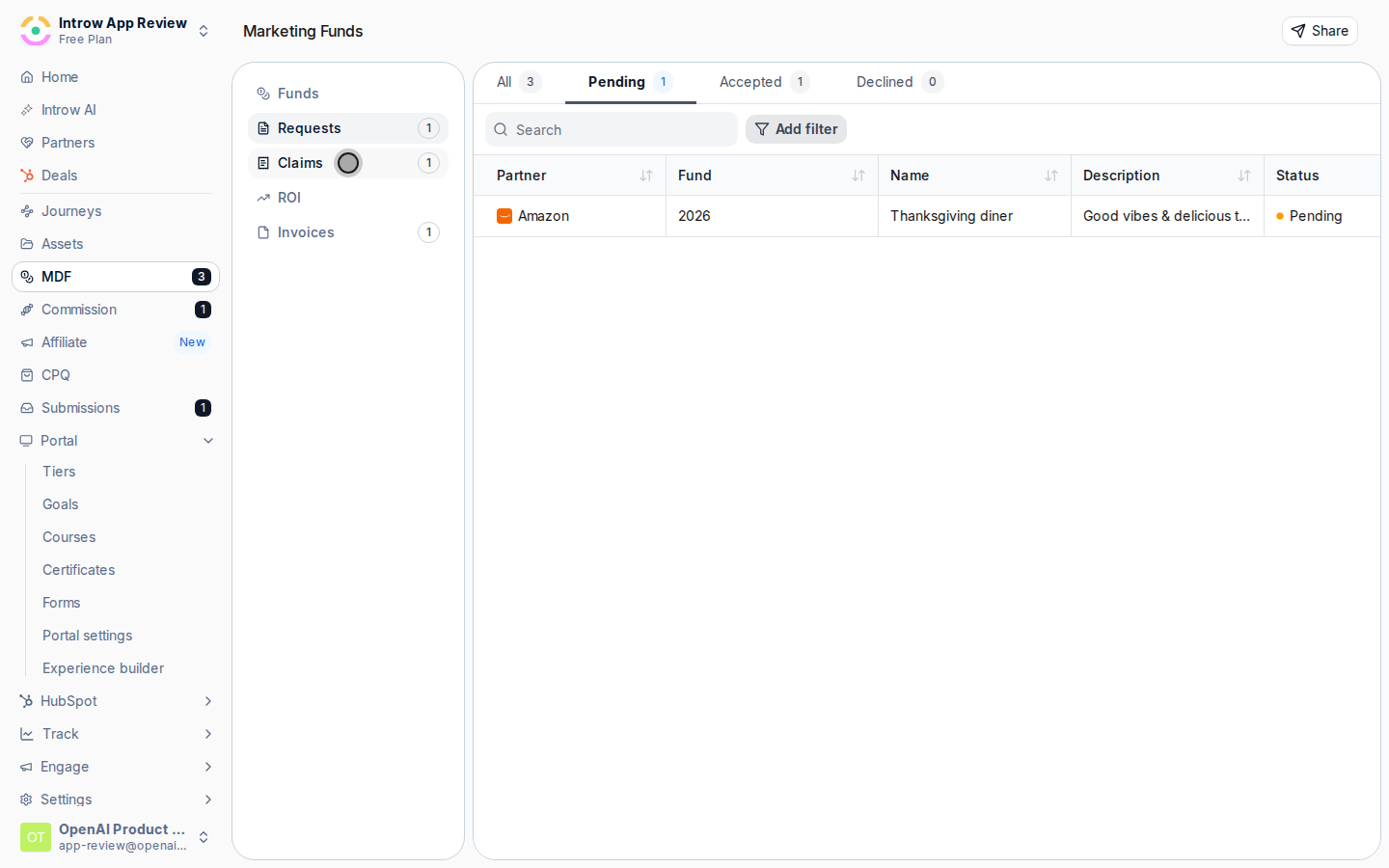
Mark the request paid
Open the funded request's record
Once claims are approved and you have reimbursed the partner, open the request’s record, from the fund’s inbox or its CRM record.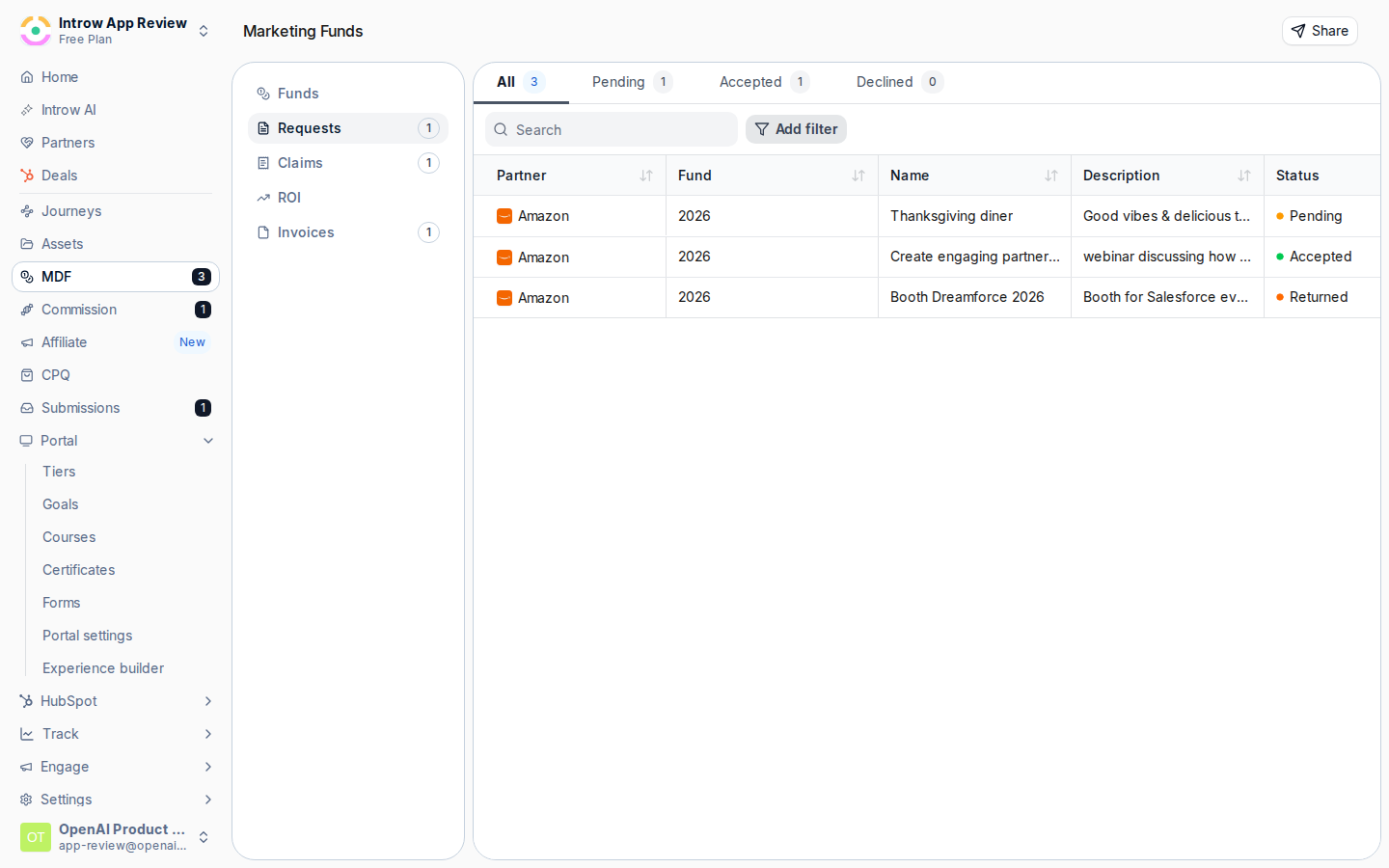
Mark it as paid
Use the record’s actions menu and choose Mark as paid, then confirm. This sets the request’s status to Paid and logs the change as an activity, closing the loop on the funded activity.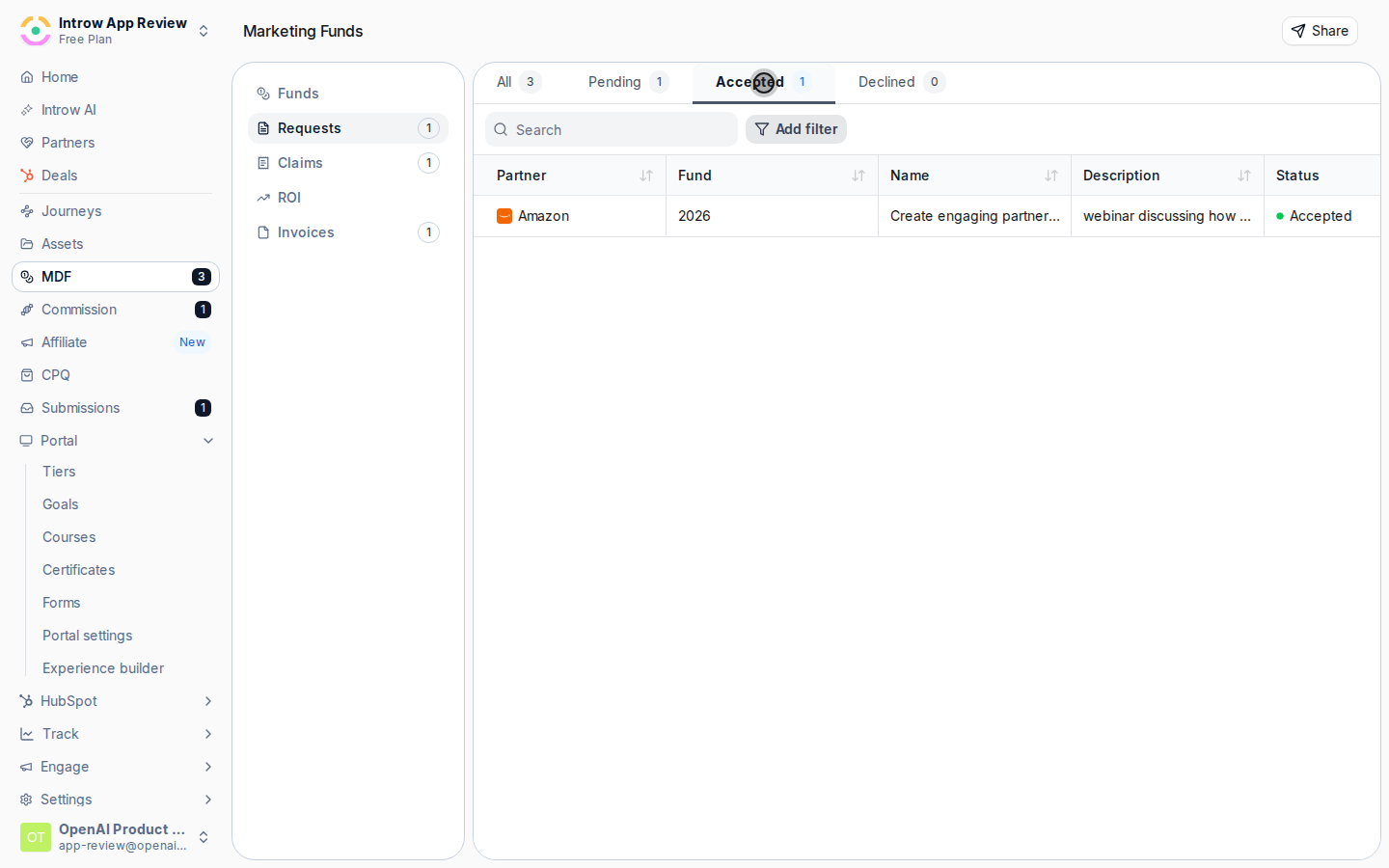
Verify it worked
Every request carries a clear decision, approved claims are recorded with their proof against the right request, and reimbursed requests show as Paid with the status synced to the CRM. The fund’s lifecycle tabs show submissions moving from pending through accepted, and partners are notified at each decision so the program runs without manual chasing.Related
Set up an MDF program
Create the fund, budget, and timelines this flow runs on.
Track ROI on a fund
Measure the return from the spend you reimburse.
Request funds by link
Give partners a way to submit the requests you review.
Implementation reference
Full lifecycle and submission configuration options.