

Your portal is where partners spend most of their time with you, and it should never be the only way in. Partner Connect brings the same partnership, under the same rules your portal defines, to the three places partner teams also work - their AI assistant, their communication tools, and their own CRM. More adoption. More revenue. Zero friction.
The problem it solves
Impact
This is the whole argument. A partner who never has to leave their assistant, their channel or their CRM to work with you will work with you more than with the vendor who sends them a login.How this area works
Headless is how Introw works, not a single feature. The vendor already runs the whole program inside HubSpot or Salesforce with agents handling the mechanical work. Partner Connect closes the other half of the loop: it extends that headless, agentic, CRM-first model to the partner, so the partnership is two-way and AI-native for both sides, not just the vendor. Where this sits in a setup. For partners who run their own CRM. The co-sell and reseller tracks bring it in once your own side is live, since it is the partner’s setup rather than yours.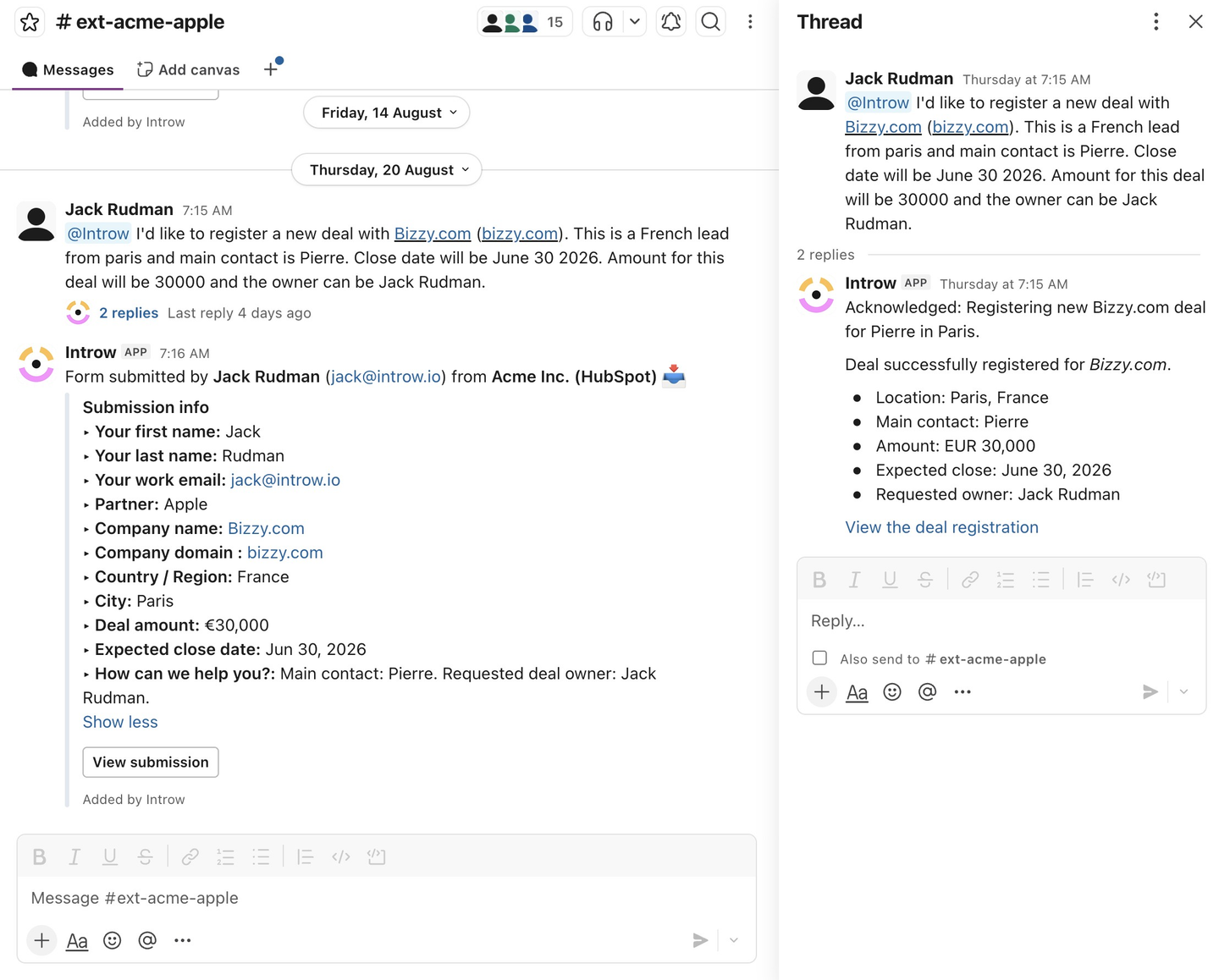
- Their AI assistant - Claude, ChatGPT, Gemini, or any MCP client. The partner asks, the program answers. Introw sits next to the partner’s other connectors, so any system they have connected can exchange data with the portal, both directions. 2. Their communication tools - Slack, Microsoft Teams, and WhatsApp. The same agent in shared channels and messaging, built for the fast commercial moves: “@Introw, share this $20k deal for me.” 3. Their own CRM - an Introw card on the partner’s own HubSpot record. One click from there opens the full co-sell view, deal coaching included, or the entire portal, signed in automatically.
Where partners start: partners.introw.io
The three surfaces are where partners work. partners.introw.io is where they set it up - and the point most easily missed is that it is theirs, not yours: one account per partner company, spanning every vendor they work with. A partner who sells three products connects their CRM once and it serves all three. A vendor portal, by contrast, belongs to one vendor and holds that vendor’s program. There a partner signs up with Google, Microsoft, or a six-digit code sent to their email. No password, and no cost to them. They connect HubSpot once, at company level, and install the MCP connector per person. They invite their own colleagues and give each one access to specific vendor portals, without you provisioning anyone. And they open every vendor portal they can reach, signed in automatically. Everything that powers Partner Connect is turned on there. Two consequences on your side. Portals appear for a partner automatically once you invite their address or allow their email domain, so there is no code to send and no access to request. And your nudge lands them at the point that matches their stage: signup, Integrations, or their home screen. The nudge email always labels that button Set up Partner Connect. The banner on the deal uses the stage’s own wording - Get started, Connect now, or Open Partner Connect.Get started as a partner
The partner front door end to end: create the account, connect the tools, reach every vendor portal. Written to the partner, so you can forward it as the first link.
What it takes from your partners
The usual question is not what Partner Connect does, it is what it costs the partner. Nothing, and no seat in your CRM. Each surface is independent - a partner can take one, two or all three, and none is a prerequisite for another.
Four pages carry this end to end, written to the partner so you can forward them:
Get started as a partner
The front door: create the account, connect the tools, reach every vendor portal.
Introw for partners
The forwardable page: permissions, what their sellers see, how to reverse it.
Roll out at scale
Sequencing across hundreds of partners, by type and by stage.
Work deals from the card
What a partner rep actually does, day to day.
What it unlocks, by partner type
The surfaces are the same for every partner; the move that matters differs by partner type:- Referral - lives in email and chat, not portals. Shares a lead in one sentence from Slack or WhatsApp, and asks their assistant what it will earn. The intro happens when it comes up, not after a login they will never do.
- Co-sell - both sales teams work one linked deal from their own CRM. The partner’s AE sees your side’s status on their own record; your AE never chases for an update.
- Reseller - registers from their own CRM the moment an opportunity appears, locking in margin and conflict protection early. Their reps ask the assistant about tier progress, certification gaps and pending commission rather than emailing their alliance manager.
- Distributor - queries the network from the assistant (sub-partner status, sell-through, commission roll-ups) and uses its own connectors to move that data into the systems the distribution business already runs on.
- Implementation - consultants self-serve technical answers 24/7 and pull your solution docs into their own workspace, so delivery never blocks on the vendor.
Run it from your AI assistant
Partner Connect is the partner-side half of Introw’s headless motion. The agentic use cases show it end to end:Deal Registration
Partners register conversationally in 90 seconds - from Claude, Slack, email, or CRM.
Deal Coaching
Every partner deal gets segment-specific guidance, delivered in the partner’s own workspace.
Enablement Support
Partner questions answered 24/7 in every language, in chat or the assistant.
Commissions & Incentives
Partners query commission status and tier progress in seconds - no portal, no finance ticket.