

What you’ll achieve
A live commission plan that reads from your CRM or billing system, filters to the deals you actually want to reward, pays a fixed fee or a percentage on the cadence you choose, and is enrolled to the right partners, so Introw calculates each partner’s commission lines automatically and they can watch their earnings build in the portal.Before you start
1
Confirm access
You need write access to commission plans.
2
Connect a data source
Connect the source the plan will read from: your CRM, or a billing integration like Stripe or Chargebee. The plan cannot calculate without one.
3
Have partners and segments ready
Decide which partners the plan applies to. If you want to target by segment or tier, set those up first so you can enroll and rate by them.
Watch it
- Video
- Click through
Steps
The plan builder is a five-step wizard: General, Data source, Conditions, Reward, and Enrollment. Work through them in order; the Continue button moves you forward and you can jump back with Back or the step list on the left at any time.Phase 1 - Create the plan
1
Start a new plan
Go to Commission plans and choose Create new plan. You can start from a blank plan or pick one of the starter templates under Or start from a template: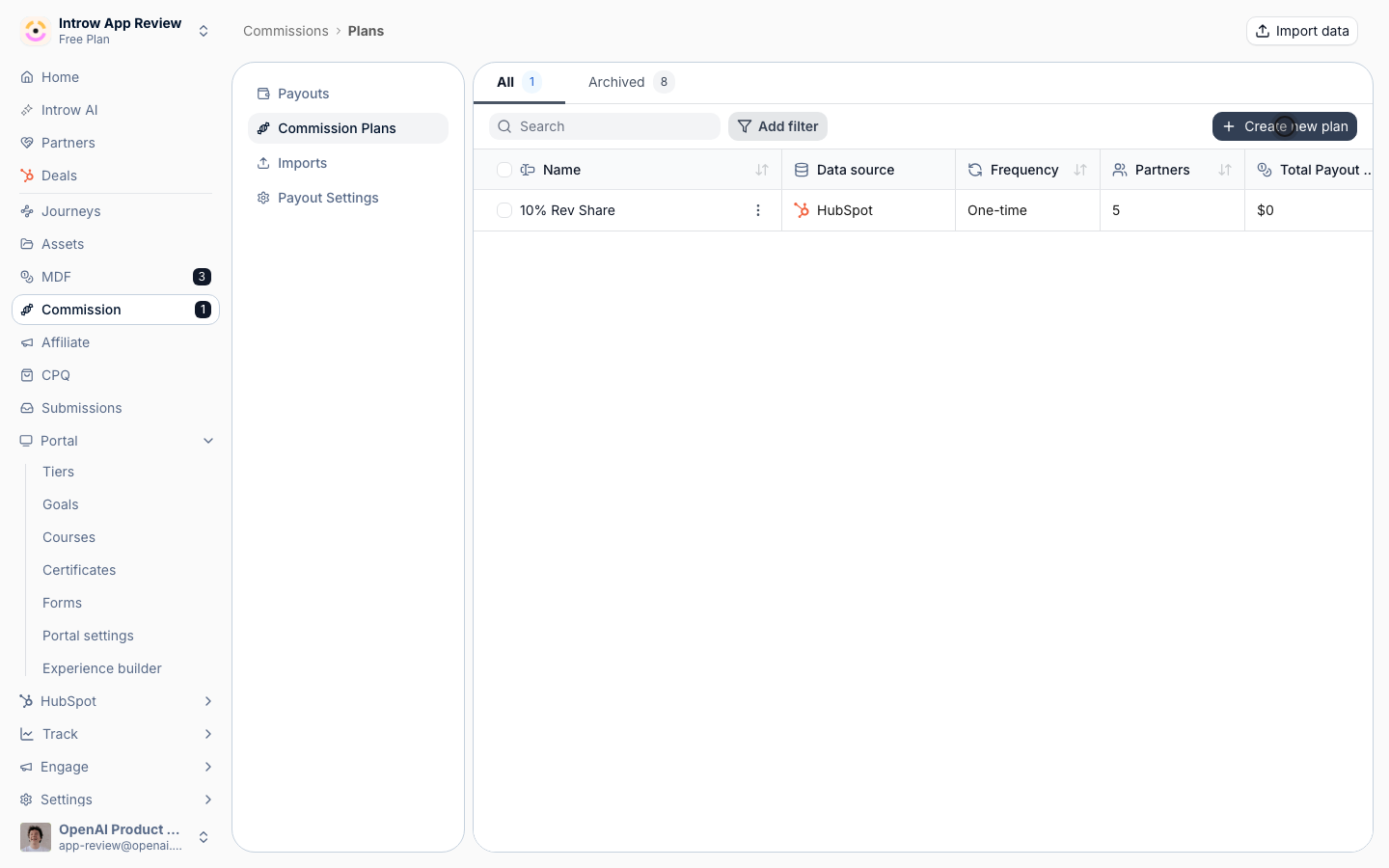
- Fixed Fee - a one-time flat payout for each qualifying record, good for per-lead or per-deal bounties.
- Revenue Share - a one-time percentage of the closed deal value, the most common referral or co-sell reward.
- Tiered - a recurring yearly percentage that can step down over time (for example 15% in year one, 10% in year two), suited to reseller or subscription margins.
2
Set the general details
On the General step, describe the plan and bound when it earns:
- Plan name - the internal name you and your team recognise the plan by (for example “Referral Plan 2026”). Required.
- Description - optional context on what the plan rewards and why; helpful when several plans run at once.
- Plan period - the Start date and end date that bound which events qualify. Events qualify from the start date onward (it defaults to the plan’s creation date if you leave it), and events after the end date do not qualify. Leave the end open with No end date for an ongoing plan, or set one for a time-boxed promotion.
Phase 2 - Connect the data source
1
Pick where the plan reads from
On the Data source step, under Select a data source, choose the system the plan calculates from. Only connected sources are selectable; a disconnected one shows Connect (or Upgrade plan if your plan does not include it).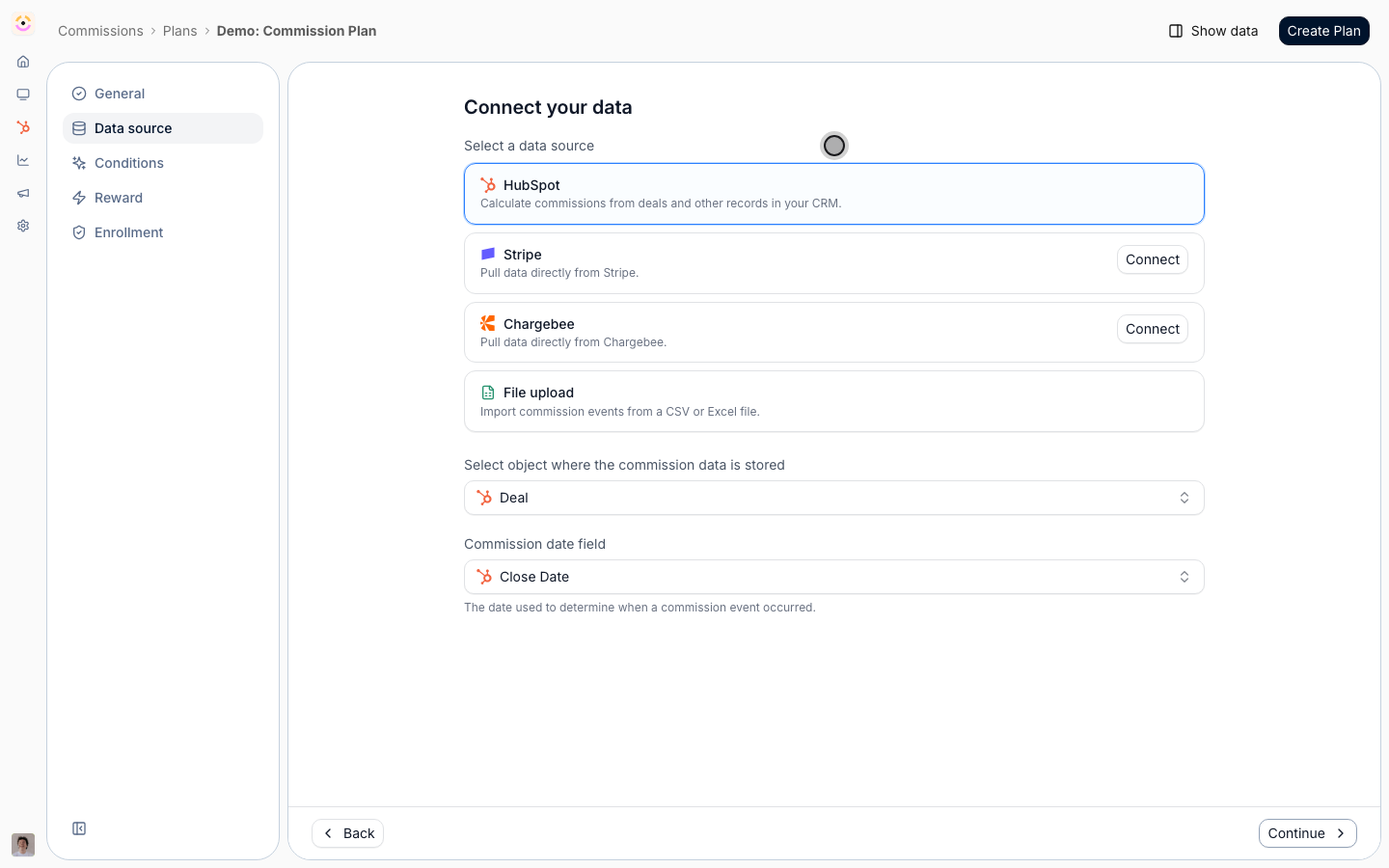
- Your CRM (shown as HubSpot, Salesforce, or TeamLeader depending on what you connected) - calculate commissions from deals and other records already in your pipeline. This is the right choice for almost every co-sell, referral, and reseller program because payouts then reconcile to the exact records sales and finance use.
- Stripe - pull billing data such as customers, subscriptions, and invoices directly from Stripe. Use this when commissions track recognised or billed revenue rather than a CRM deal.
- Chargebee - the same billing-based calculation sourced from Chargebee.
2
Select the object and date
Tell the plan which records to read and how to time them: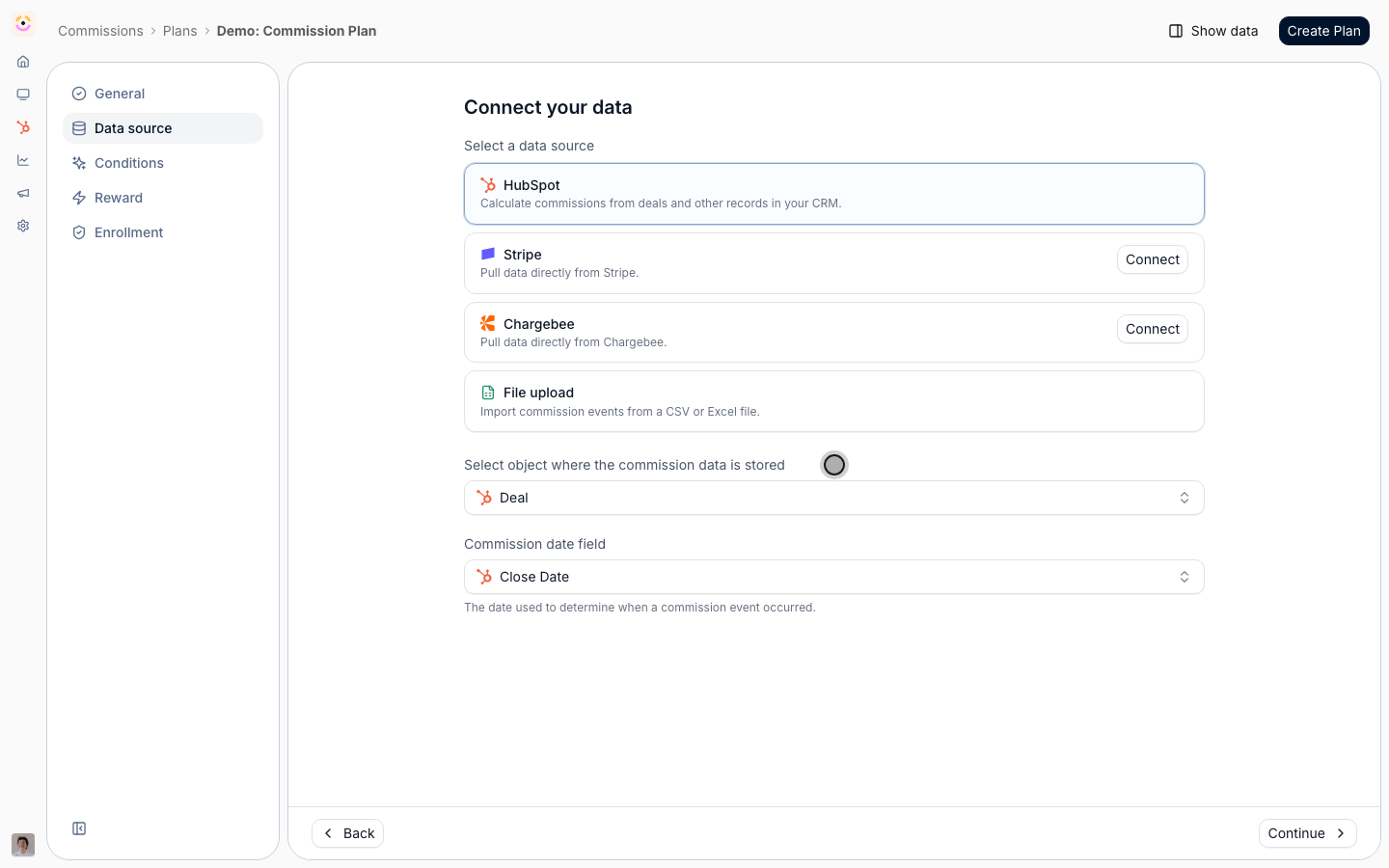
- Select object where the commission data is stored - the record type the plan watches. For a CRM source this is typically your deal object; for a billing source it is the billing object (for example Subscription, Invoice, or Customer). Every qualifying record of this type can generate a commission line.
- Commission date field - the date Introw uses to decide when a commission event occurred, which determines the period a resulting line falls into. Pick the date that best represents “earned” for your program, such as the close date for deals or the billing date for invoices.
3
Preview the matching records
Open the Data preview (use Show data in the header if the panel is hidden) to sanity-check the source before you go further. It reports how many records would qualify over a baseline window you choose - 90 days, 180 days, or 1 year - so you can confirm the volume looks right. Use Configure to pick which properties appear as columns in the preview table. If the count is zero or wildly off, revisit the object and date selections before adding conditions.
Phase 3 - Decide which records qualify
1
Add eligibility conditions
On the Conditions step, narrow the source down to only the records that should earn. The step reads “A commission is earned when a record matches the following” and starts with no conditions, which means everything qualifies, so add filters to be deliberate.
- Add condition - add a property filter, such as deal stage is Closed Won or amount is greater than a threshold. Stack several and they combine with And, so a record must meet all of them.
- Add ‘OR’ condition - start a separate group that qualifies records meeting a different set of rules, letting you express “this set, or that set” eligibility.
Phase 4 - Configure the reward
1
Choose the reward type and frequency
On the Reward step, set what a qualifying record pays and how often: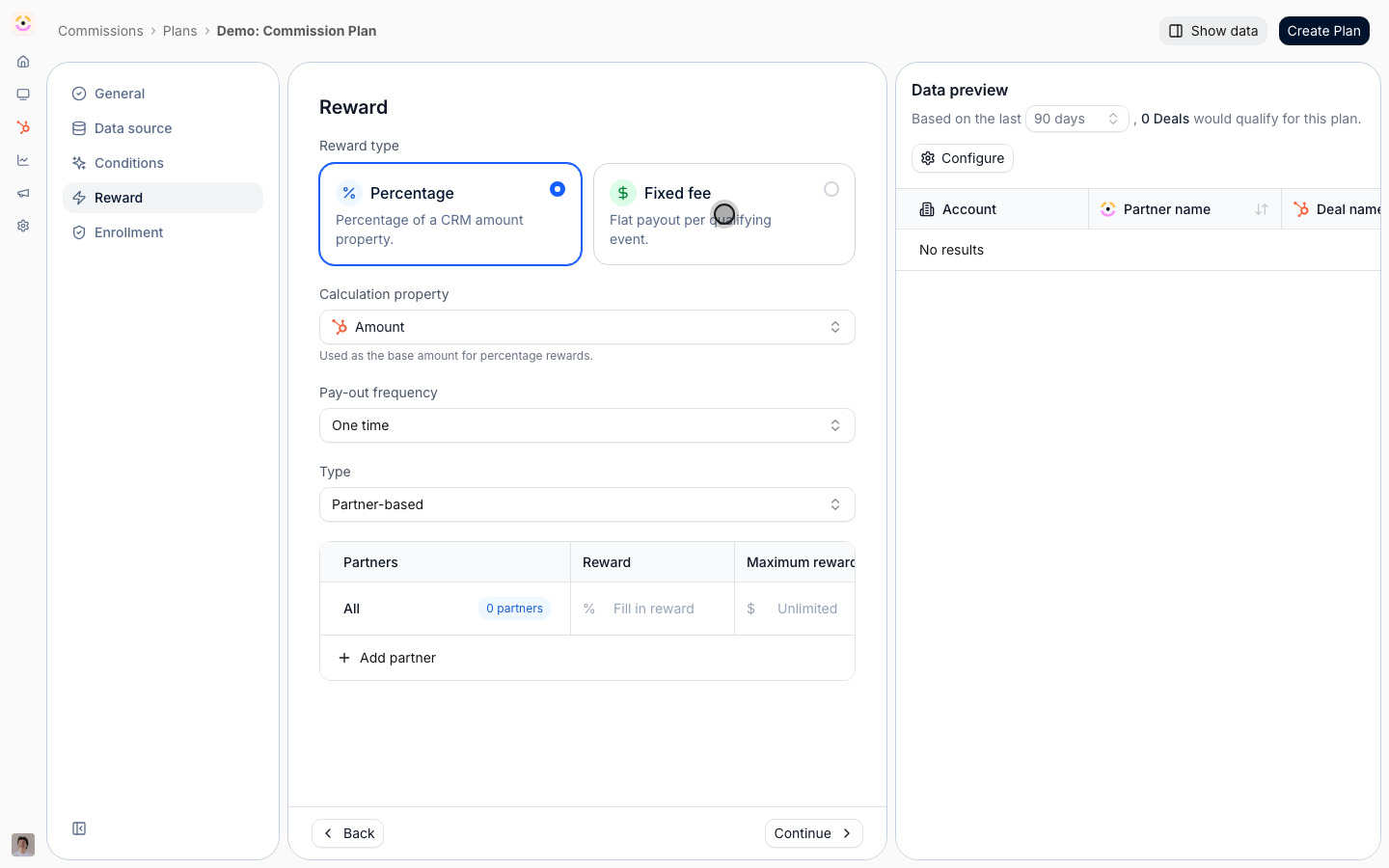
- Reward type - choose Fixed fee for a flat payout per qualifying event, or Percentage for a percentage of a CRM amount property. Fixed fee suits per-lead bounties; percentage suits revenue share and margin. A fixed fee is paid in your company currency, also on a deal in another currency.
- Calculation property - shown for Percentage rewards only: the amount property the percentage is applied to (for example the deal value). This is the base the rate multiplies.
- Pay-out frequency - choose One time for a single payout per record, or Every month or Every year for a recurring reward that pays across periods (useful for subscription or retainer commissions). A recurring frequency turns on the period schedule below.
- Frequency periods - for recurring rewards, define the Start and End months or years that the reward runs across, using Add period for additional bands. Leave the final period open with Never ends for an open-ended tail that keeps paying as long as the record qualifies.
2
Set the rates by audience
Use the rates table to set how much partners earn, and whether everyone earns the same: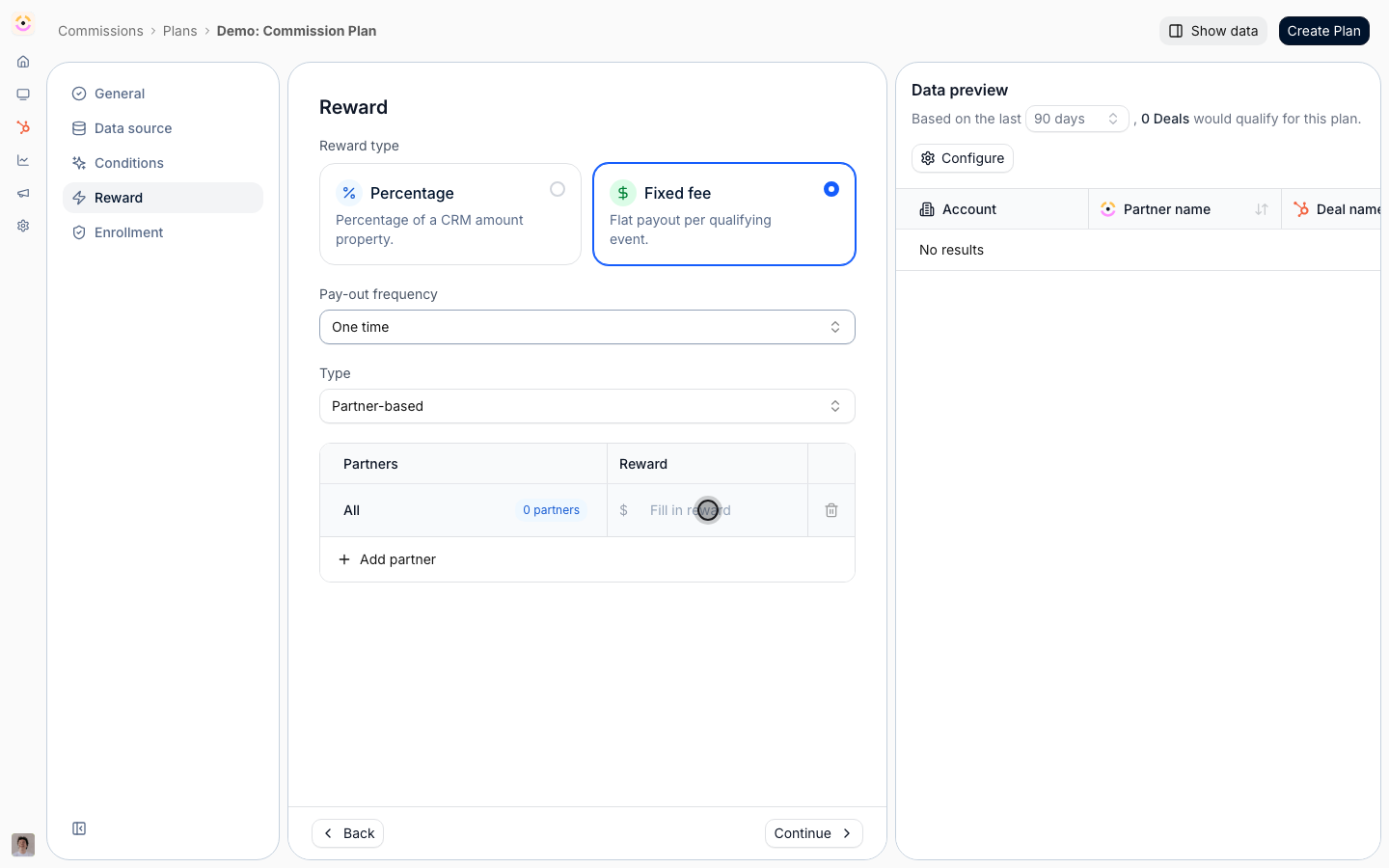
- Type - choose how rates are targeted: Partner-based, Segment-based, or Tier-based. Tier and segment targeting let you reward stronger partners or specific groups differently from the default.
- Reward rate - the amount or percentage for each row. The default row labelled All applies to every enrolled partner who is not matched by a more specific row.
- Add specific rows with Add tier, Add segment, or Add partner to override the default for those audiences. Partner-specific rates take precedence over tier and segment rates, so use them for genuine exceptions.
- Maximum reward - an optional cap per row that limits how much a single rate can pay; leave it Unlimited unless you need to bound exposure. Set it deliberately, as a low cap can quietly shrink payouts.
Phase 5 - Enroll partners and launch
1
Enroll the right partners
On the Enrollment step, choose who the plan applies to. A plan only generates commission for enrolled partners, so this step is what activates it.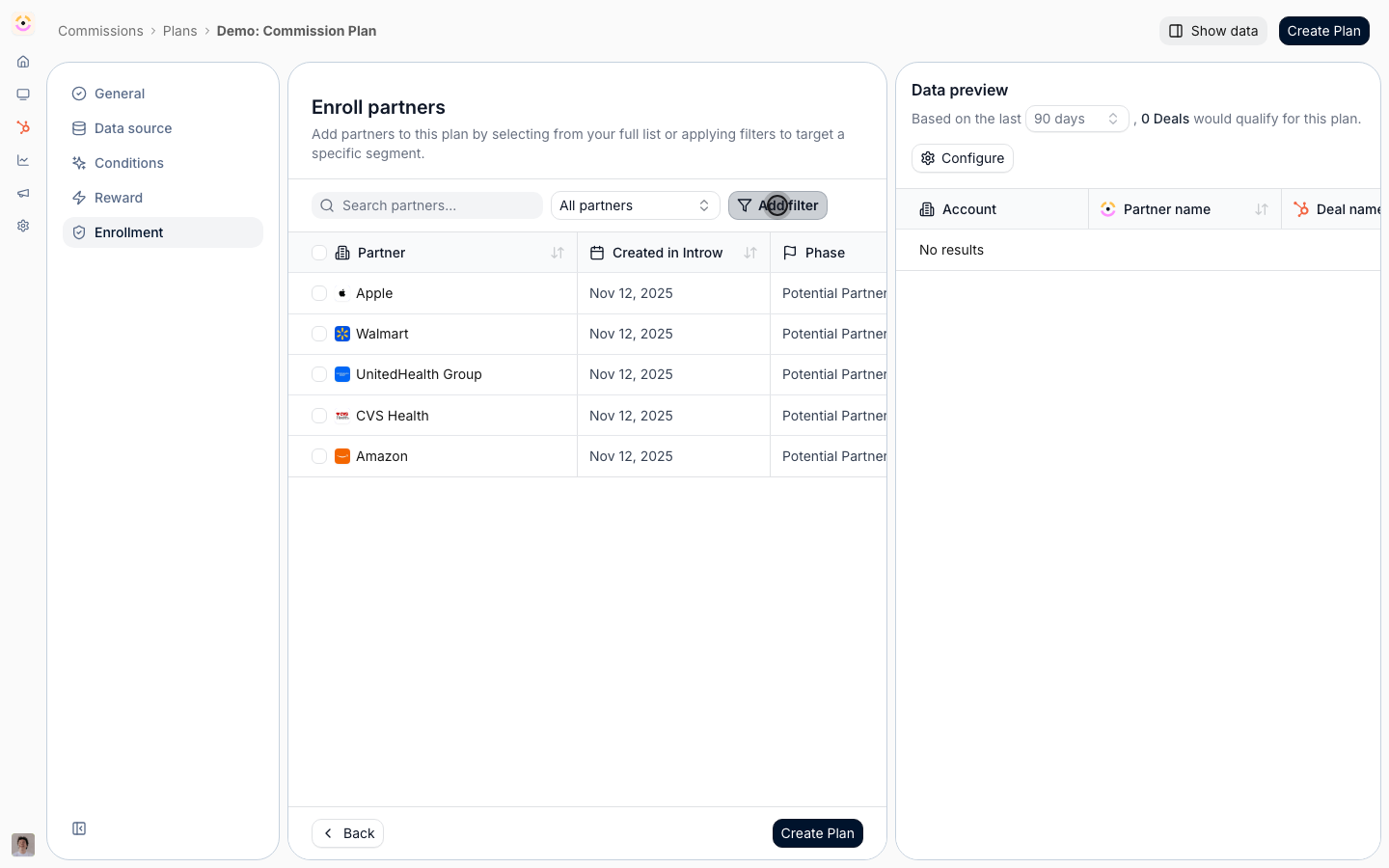
- Select partners directly from the list with the checkboxes, or
- Apply filters such as Phase, Tier, Experience, or Manager to target a group, or pick a partner segment to enroll many at once and keep the audience aligned with that segment.
2
Save and launch the plan
Choose Create Plan (or Save when editing) to launch it. The plan becomes active for the enrolled partners and Introw begins calculating commission lines for their qualifying records.If you later edit a live plan, the Update commission plan dialog appears. When you changed Starts on or Ends on, it opens with a Plan period has changed notice that tells you to turn on Recalculate expected commission to recalculate all expected lines, including the ones outside the new period. Without it, lines that already exist stay as they are. By default already-earned expected commission stays as it is; turn on Recalculate expected commission and set the Since date if you want the change to reprocess pending lines from that point. Use this deliberately, since it recomputes amounts partners may already be expecting.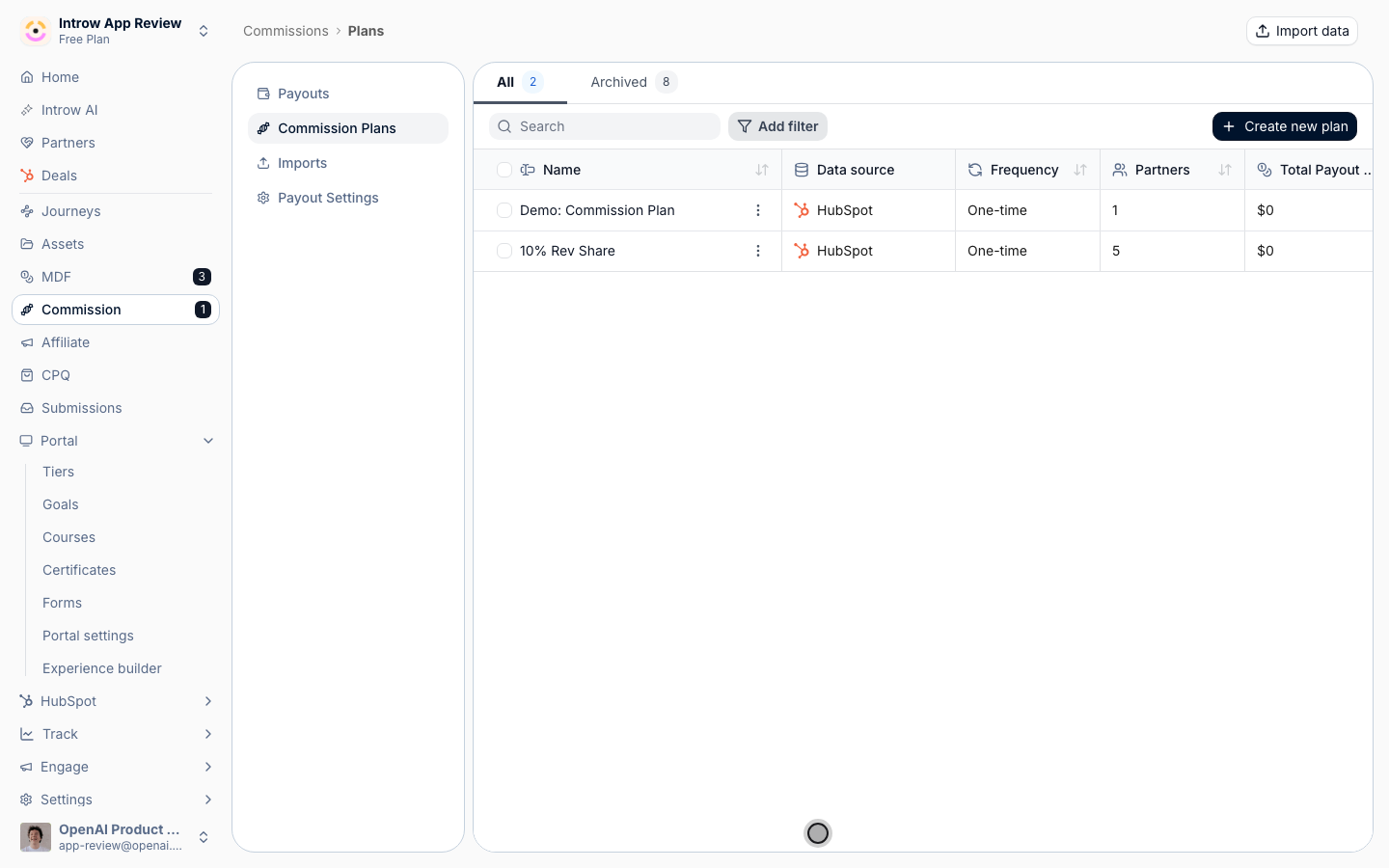
Verify it worked
The plan shows as active in the plans list with the partners you enrolled. As qualifying records come in, commission lines appear on the commission dashboard and on each partner’s payout panel, traceable back to their source record, and enrolled partners can see their building commission in the portal. If no lines appear, confirm enrolled partners have records that meet the conditions and that the data preview returned matching records.What your partners experience
Once the plan is live and you have added a commissions section to their experience, enrolled partners watch their earnings build in real time in the portal: each qualifying deal, the expected amount, and - once you run a payout - a statement they can open. This is what lets a partner self-serve “what am I earning, and when do I get paid?” without asking your team, so the work you do here shows up directly as trust on the partner side.Related
Review and adjust commission lines
Check, decline, postpone, or correct the lines this plan generates.
Run a payout cycle
Turn approved lines into paid partner payouts.
Create a dynamic segment
Enroll and rate partners by segment.
Implementation reference
Full configuration options.