

What you’ll achieve
Internal channels that surface the partner events you choose, and shared partner channels where you and each partner collaborate, so partner activity reaches your team and your partners in the chat tool they already use.Before you start
1
Connect Slack or Teams
The chat integration must be connected first. See Connect Slack or Connect Microsoft Teams.
2
Confirm your Introw permission
You need permission to manage integrations in Introw to edit channel mappings and notification settings.
3
Create the channels you need
Create the internal and shared channels in Slack or Teams first. For a shared partner channel, invite the partner in your chat tool so the channel exists before you map it.
Steps
Inform your team with internal channels
1
Open the connected integration
Go to Integrations, then open the connected Slack or Microsoft Teams tile to reach its configuration page. The header shows Connected by and a green status when healthy.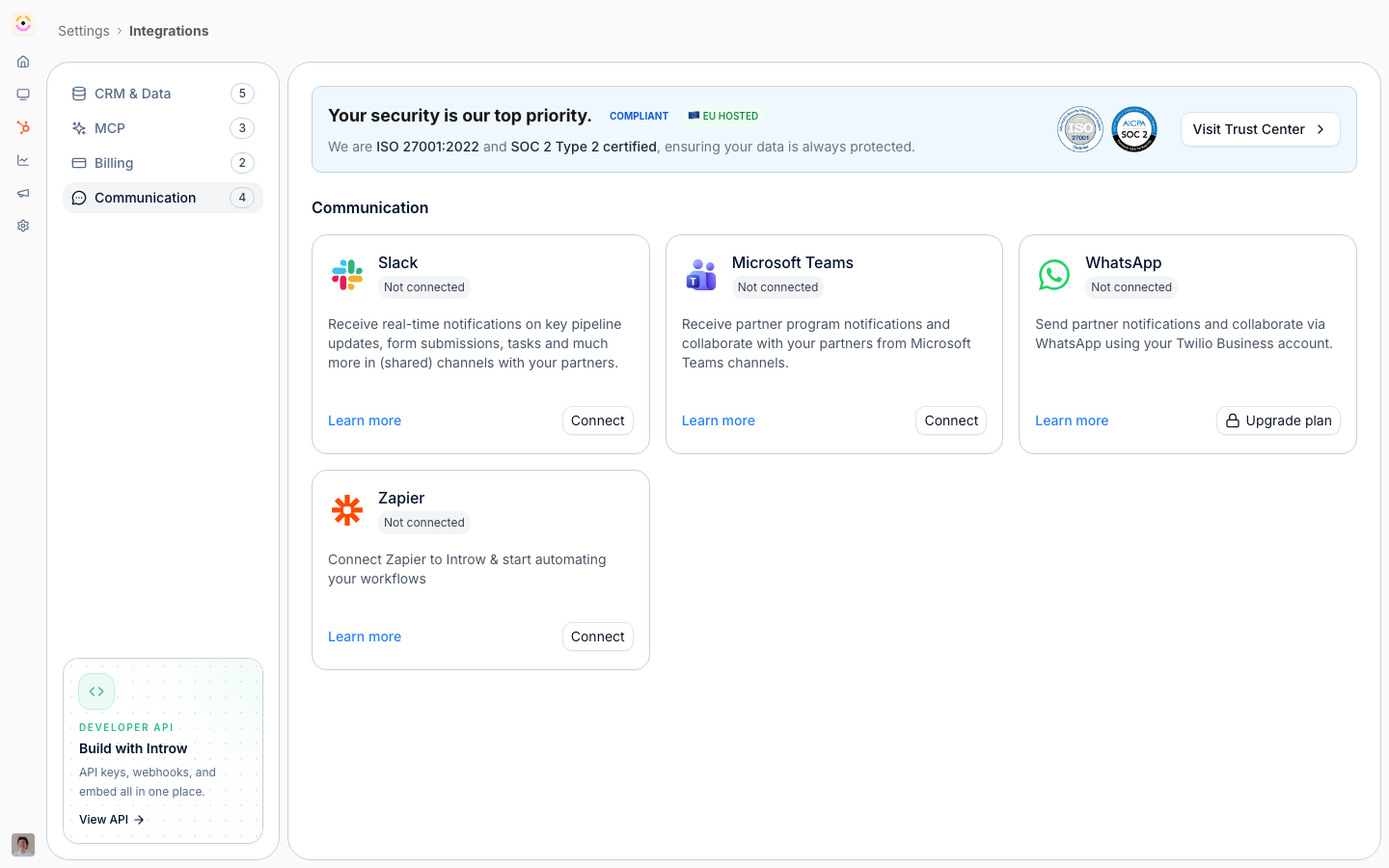
2
Add an internal channel
Under Internal channels, map a channel that should receive notifications about your partners. Each row pairs a partner scope with a channel:
- Partner scope - choose All partners to post every partner’s activity to this channel, or pick one or more specific partners to keep a channel focused on just them. Use all partners for a general partnerships channel and specific partners for a high-touch account.
- Channel - the internal Slack or Teams channel the activity posts to. Only non-shared (internal) channels appear here. On Slack, every public channel in the workspace is listed, including ones you have not joined. A private channel is listed only when the Introw app is in it and you are a member, so if one is missing, add the Introw app to that channel in your chat tool first, then reopen the list.
3
Choose which events post
On the right, Notification Settings controls which internal notifications are sent to your chat tool. Toggle the event types your team cares about, grouped by the kind of activity:
- Pipeline and deal updates - turn on to post when a partner-linked deal changes stage or value, so your team sees movement in real time.
- Form submissions - turn on to post when a partner submits a form, such as a deal or lead registration, so submissions are actioned quickly.
- Tasks - turn on to post when partner tasks are created or change, so nothing is dropped.
- Other partner activity - additional event types appear here based on your CRM object setup; enable the ones worth a notification and leave the rest off to avoid noise.
Open shared channels with partners
1
Add a partner channel
Under Partner channels, map a shared channel for collaboration and shared notifications with a specific partner. Each row pairs a partner with a shared channel:
- Partner - the partner this channel belongs to. Pick the partner you collaborate with there.
- Shared channel - the shared Slack or Teams channel that connects you and the partner. The partner must already be in the channel in your chat tool. This is where shared updates and partner-facing actions post for that partner.
2
Confirm the mappings saved
Mappings save automatically as you set them, with a success message on each change. Review the Internal channels and Partner channels lists to confirm each row has both a partner (or scope) and a channel selected, since rows without a channel are ignored.
Ask Introw in Slack and Microsoft Teams
Introw runs two AI agents inside Slack and Microsoft Teams, so partners and your team get answers and take action without leaving chat. Both read live from your CRM source of truth and act only within each person’s own access - partners stay scoped to their portal, your team stays scoped to theirs.Partner support agent - shared channels
In a shared partner channel, partners just @-mention Introw to ask the same questions they could in the portal - deal status, commissions, tiers, content, or even registering a deal - and get an instant, scoped answer.
Internal agent - internal channels
In your internal channels, your team @-mentions Introw to get insight on the partner ecosystem and act on it - handle open form submissions, surface best-performing partners, check pipeline, and update partner records.
Partners self-serve in shared channels
@-mention Introw in a shared partner channel and the partner support agent answers from your knowledge base and live portal data, scoped to that partner. It is the same agent partners use in the portal, now in Slack and Microsoft Teams: it can answer questions in any language and take action on the partner’s behalf - register a deal, update a record, or surface the right asset - without anyone on your team being pulled in.Your team gets ecosystem insight in internal channels
@-mention Introw in an internal channel and the internal agent answers questions about your whole program and acts on it, scoped to your access - no portal hunt and no RevOps ticket. For example:- Handle open work - “Show me open form submissions,” then approve, reject, or follow up on deal and lead registrations right from chat.
- Spot what’s working - “Who are my best-performing partners this quarter?” to pull ecosystem performance on demand.
- Update partners - “Move Acme to Gold” or “add a note to this partner” to change partner records on the fly.
- Check the numbers - “What’s this partner’s pipeline and commission status?” for a live readout.
Both agents depend on the partner support agent being
enabled. Each agent only ever sees and does what the person talking to it is allowed to -
partners are scoped to their own portal data, your team to your program.
Verify it worked
Trigger a partner event that matches an enabled notification, for example move a partner-linked deal to a new stage, and confirm the message posts to the mapped internal channel. For a partner channel, post or take a shared action and confirm it lands in the shared channel with that partner. The configuration page keeps your channel rows and event toggles as you left them.Related
Connect Slack
Connect Slack before configuring it.
Connect Microsoft Teams
Connect Teams before configuring it.
Partner notifications
Choose what partners receive in shared channels.
Implementation reference
Full configuration options.