> ## Documentation Index
> Fetch the complete documentation index at: https://docs.introw.io/llms.txt
> Use this file to discover all available pages before exploring further.
# Control who gets notified
> Scope each notification to the right partners and teammates using segments, per-channel toggles, and internal role and user settings to cut noise.
## What you'll achieve
Each notification scoped to the partners and teammates it applies to, on the channels you choose, so partners receive only relevant updates and your team sees only the partner activity they own.
## Before you start
Decide which events matter to your program before you tune who receives them. See [Every notification Introw sends](./every-notification-introw-sends) for the full list.
Anything narrower than your organisation-wide baseline is expressed with a segment, and an overriding segment needs at least one condition. Build them first if needed. See [Segments](/features/partners/segments).
## Steps
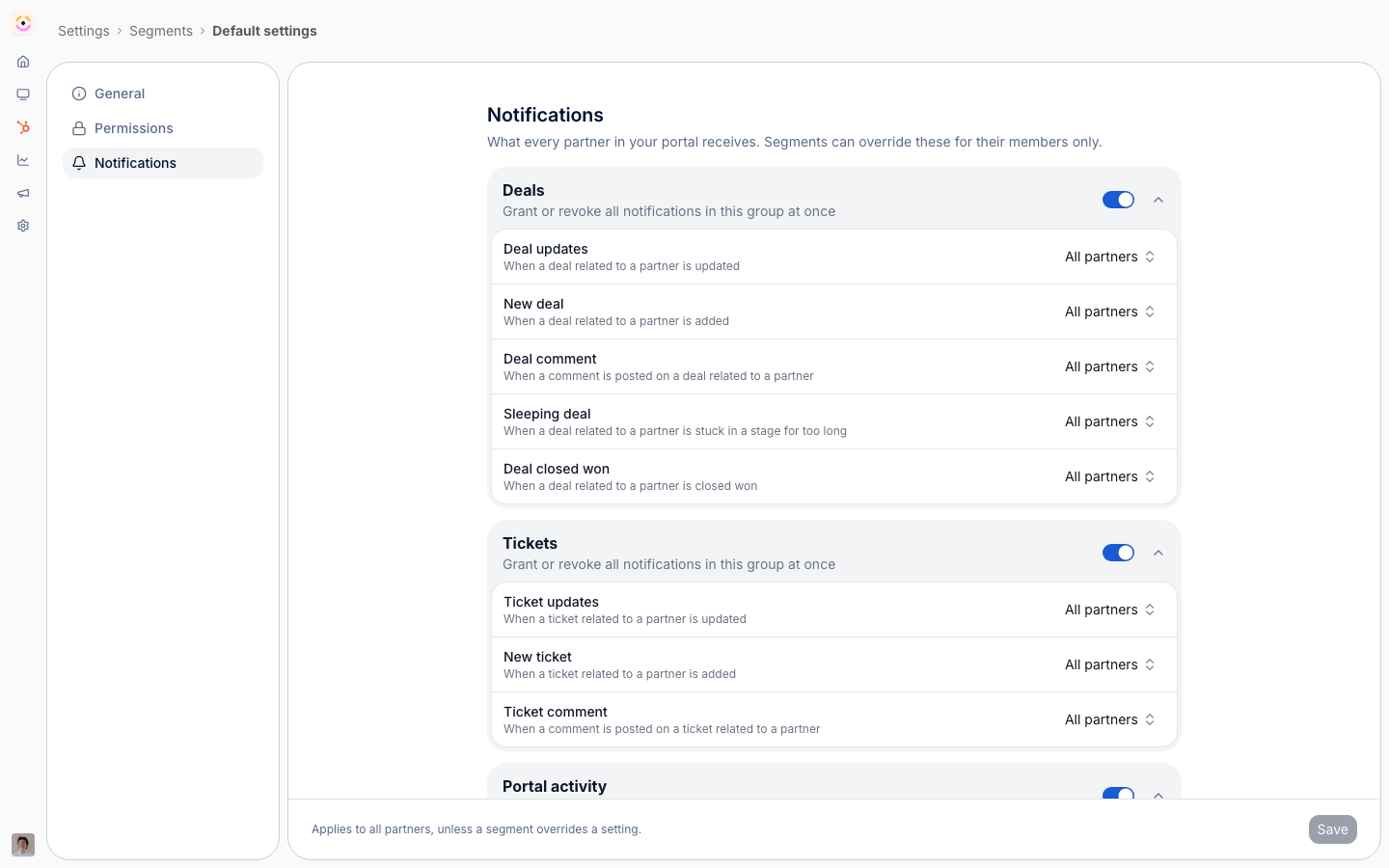
Go to [Default settings](https://app.introw.io/settings/segments/default) and open the **Notifications** tab. Give each event its recipients:
* **All partners** - everyone the event applies to.
* **Collaborating only** - just the contacts assigned as collaborators on the record. Offered only for events attached to a CRM record, where collaboration means something.
* **Disabled** - the event does not send.
This is the floor of your program. A brand-new partner, and any partner who matches no segment, gets exactly what you set here.
 Open the segment that audience is defined by, go to its **Notifications** tab, and switch on **Override the default for this segment**. Until you do, the segment changes nothing, so creating a segment to target an announcement has no notification side effects.
* **When to override** - program-specific messages that should not reach every partner, such as a tier-only update or a region-specific deal notification.
* **Both directions** - an override replaces the default for that segment's members, so it can hold an event back as well as open it up.
* **It has to target a subset** - a dynamic segment with no conditions matches everyone, so it cannot override. Add at least one condition, or keep using it purely for targeting.
Recipients above govern **email**. Which partner events reach a partner's chat channel is set per platform on that chat integration, on its **Partner channels** tab, because a channel belongs to a whole partner rather than to a person. Chat cannot be targeted per segment. Some notifications are email-only. See [Channels](/features/engagement/channels).
For notifications that also reach internal users, role and user settings decide who on your team is notified. Choose the reach that fits each role:
* **All partners** - the person is notified about every partner.
* **Only their own partners** - limited to partners they own or manage.
* **Only where they collaborate** - limited to the specific deals or records they are a collaborator on.
* **Off** - the person is not notified for that type.
Set a sensible default at the role level, then let individuals fine-tune their own preferences.
When a contact matches several override segments that disagree on the same event, the most permissive one wins, so an event enabled in any of them reaches the contact and the wider audience applies. Anything no override segment mentions falls through to the default.
Open a partner contact's **Notifications** tab and Introw shows the three-layer cascade that decides each event, top to bottom:
1. **All partners · Default** - the organisation default from [Default settings](https://app.introw.io/settings/segments/default), with a link to edit it.
2. **Matched override segments** - each segment the contact belongs to that overrides at least one event, named and linked, with the number of events that segment decides.
3. **This contact** - the events this contact has opted out of themselves.
Every row on the tab is badged with the layer that decided it, so you can see at a glance whether a value comes from the default, a segment override, or the contact's own opt-out, and where to go to change it.
On the contact's **Notifications** tab, turn off any event the layers above leave available. Contact-level toggles can only opt out of an event that is available; they cannot re-enable one a higher layer has locked to off. If a row is locked, use the links on the cascade card to edit the default or the matching segment.
The rule is enforced when the change is saved rather than only hidden in the interface, so an opt-out recorded against a locked event is stripped before it is stored. No screen can claim an opinion the organisation default or a segment owns.
Partners can also opt out of non-essential emails from their own settings, and Introw honors that alongside the cascade. Keep essential, action-driving notifications on and avoid enabling low-value ones, so partners stay opted in to the messages that matter.
## Verify it worked
On [Segments](https://app.introw.io/settings/segments), the **Notifications** column reads **Default** for every segment that follows your baseline and shows the exact difference for every segment that does not, so your whole setup is one screen. Then open a contact in the audience you scoped and confirm their cascade names the layer you expect. After the next real event, the **Last sent** time updates and **Insights** on [Notification settings](https://app.introw.io/settings/notifications) shows who it reached.
## Related
The full catalog of what you can turn on.
Build the partner audiences you scope notifications to.
Set up email, Slack, and Teams delivery.
Full configuration options for notifications.
Open the segment that audience is defined by, go to its **Notifications** tab, and switch on **Override the default for this segment**. Until you do, the segment changes nothing, so creating a segment to target an announcement has no notification side effects.
* **When to override** - program-specific messages that should not reach every partner, such as a tier-only update or a region-specific deal notification.
* **Both directions** - an override replaces the default for that segment's members, so it can hold an event back as well as open it up.
* **It has to target a subset** - a dynamic segment with no conditions matches everyone, so it cannot override. Add at least one condition, or keep using it purely for targeting.
Recipients above govern **email**. Which partner events reach a partner's chat channel is set per platform on that chat integration, on its **Partner channels** tab, because a channel belongs to a whole partner rather than to a person. Chat cannot be targeted per segment. Some notifications are email-only. See [Channels](/features/engagement/channels).
For notifications that also reach internal users, role and user settings decide who on your team is notified. Choose the reach that fits each role:
* **All partners** - the person is notified about every partner.
* **Only their own partners** - limited to partners they own or manage.
* **Only where they collaborate** - limited to the specific deals or records they are a collaborator on.
* **Off** - the person is not notified for that type.
Set a sensible default at the role level, then let individuals fine-tune their own preferences.
When a contact matches several override segments that disagree on the same event, the most permissive one wins, so an event enabled in any of them reaches the contact and the wider audience applies. Anything no override segment mentions falls through to the default.
Open a partner contact's **Notifications** tab and Introw shows the three-layer cascade that decides each event, top to bottom:
1. **All partners · Default** - the organisation default from [Default settings](https://app.introw.io/settings/segments/default), with a link to edit it.
2. **Matched override segments** - each segment the contact belongs to that overrides at least one event, named and linked, with the number of events that segment decides.
3. **This contact** - the events this contact has opted out of themselves.
Every row on the tab is badged with the layer that decided it, so you can see at a glance whether a value comes from the default, a segment override, or the contact's own opt-out, and where to go to change it.
On the contact's **Notifications** tab, turn off any event the layers above leave available. Contact-level toggles can only opt out of an event that is available; they cannot re-enable one a higher layer has locked to off. If a row is locked, use the links on the cascade card to edit the default or the matching segment.
The rule is enforced when the change is saved rather than only hidden in the interface, so an opt-out recorded against a locked event is stripped before it is stored. No screen can claim an opinion the organisation default or a segment owns.
Partners can also opt out of non-essential emails from their own settings, and Introw honors that alongside the cascade. Keep essential, action-driving notifications on and avoid enabling low-value ones, so partners stay opted in to the messages that matter.
## Verify it worked
On [Segments](https://app.introw.io/settings/segments), the **Notifications** column reads **Default** for every segment that follows your baseline and shows the exact difference for every segment that does not, so your whole setup is one screen. Then open a contact in the audience you scoped and confirm their cascade names the layer you expect. After the next real event, the **Last sent** time updates and **Insights** on [Notification settings](https://app.introw.io/settings/notifications) shows who it reached.
## Related
The full catalog of what you can turn on.
Build the partner audiences you scope notifications to.
Set up email, Slack, and Teams delivery.
Full configuration options for notifications.