> ## Documentation Index
> Fetch the complete documentation index at: https://docs.introw.io/llms.txt
> Use this file to discover all available pages before exploring further.
# AI Approvals
> Enable AI validation on a form, write or generate review rules, set a certainty threshold, and let the AI accept, decline, or return submissions.
## Where it lives
AI Approvals sits under **Portal**, at [Forms](https://app.introw.io/forms).
 ## Before you start
| You need | Why | Fix it |
| ---------------------------- | ------------------------------ | --------------------------------------------------------------------------------- |
| The AI Agent module | On by default on your plan | **Request access** |
| A form with an approval step | The AI recommends on that step | [Build a form](/features/forms/form-builder/guides/build-and-publish-a-form) |
| Write access to the form | To turn the recommendation on | [Internal roles](/features/access/team-management/guides/create-an-internal-role) |
## How it works
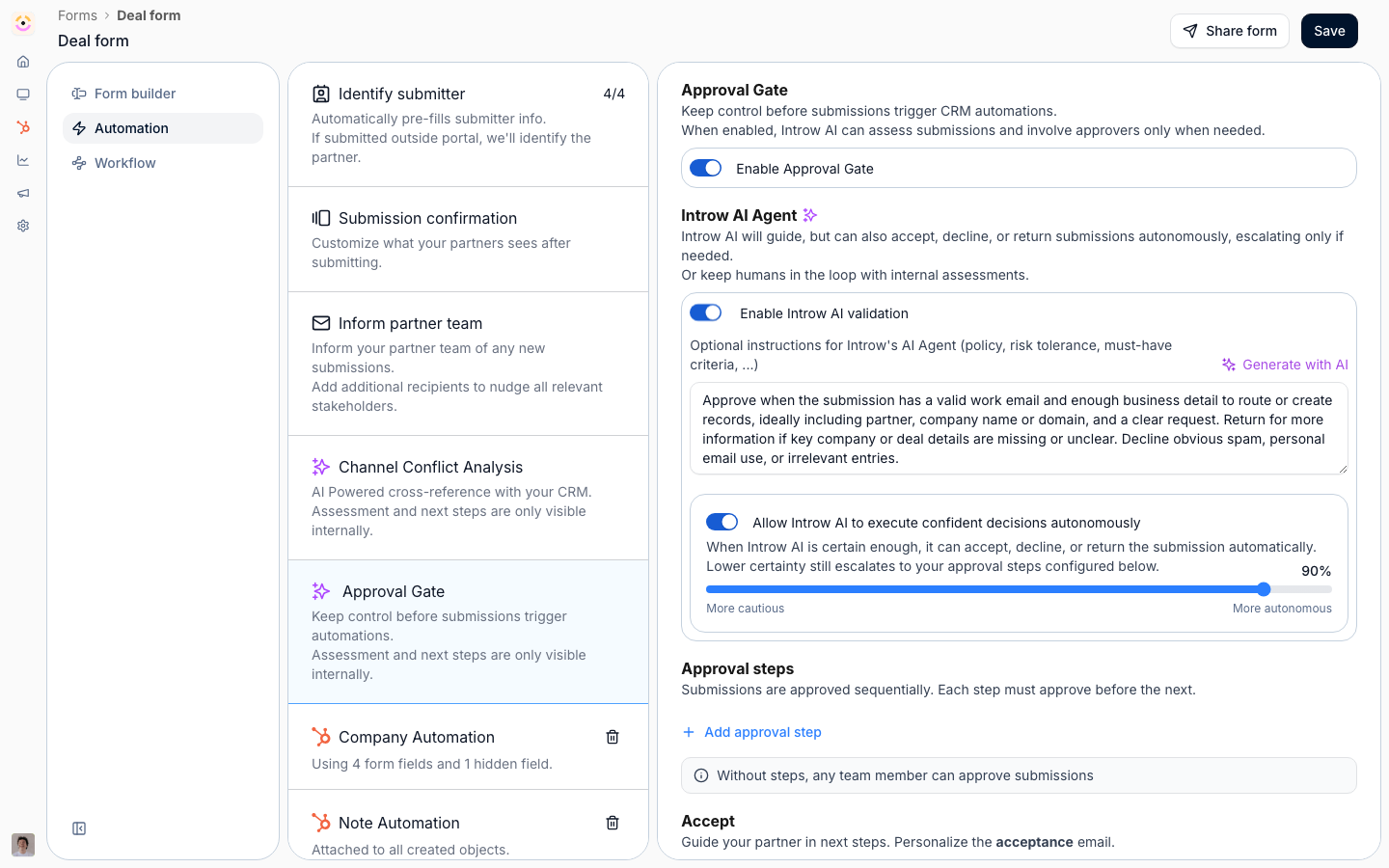
AI Approvals is configured per form, on the form's **automation** under manual acceptance. Toggle **Enable Introw AI validation** and the AI reviewer joins that form's [approval workflow](/features/forms/submissions-approvals). You give it **instructions** - the rules a submission has to meet, written in plain language - and Introw can generate a first draft of those instructions from the form's own fields, which you then edit.
When a partner submits, the AI reads the submission and its attachments, checks it against your instructions, and produces a verdict with reasoning: accept, decline, or return for more information. By default it **guides** - the verdict and reasoning show up for your human approvers, who make the call. Turn on **auto-execution** and set a **certainty threshold** (defaults to 90) and the AI acts on its own when its confidence is at or above that bar, and escalates anything below it to your [acceptance steps](/features/forms/submissions-approvals). Because it runs on the form layer, the same reviewer covers deal registrations, [MDF](/features/mdf) requests, claims, ROI, and invoices, and shared leads.
### Guide vs. auto-execute
* **Guide (default)** - the AI assesses every submission and posts its verdict and reasoning; a human still accepts, declines, or returns.
* **Auto-execute** - above the certainty threshold the AI accepts, declines, or returns on its own; below it, the submission escalates to a human. This is how a stack of routine, well-documented submissions clears without sitting in a queue.
### Where it fits the approval flow
AI validation runs first, then your sequential human acceptance steps handle whatever escalates. [Channel conflict](/features/ai/channel-conflict) screening runs alongside it as the conflict-specific check on deal registrations.
```mermaid theme={"theme":{"light":"github-light","dark":"github-dark"}}
flowchart LR
submit["Submission arrives"] --> ai["Introw AI validation"]
ai -->|above threshold| auto["Auto accept / decline / return"]
ai -->|below threshold| human["Human acceptance steps"]
```
## Settings & configuration
Configured on the form editor's automation tab, under manual acceptance.
### Enable Introw AI validation
Turn on validation for the form so the AI reviews its submissions.
### Instructions
Write the rules the AI checks each submission against, or generate a draft from the form's fields and edit it.
### Auto-execution
Let the AI act on its own above the certainty threshold; leave it off to keep the AI advisory while humans decide.
### Certainty threshold
Set how confident the AI must be to act without a human (defaults to 90). Lower it to automate more, raise it to escalate more.
## How-to guides
*None yet.*
## Troubleshooting
Auto-execution acts on real submissions - accepting an MDF claim or a deal registration writes to your CRM and can draw down budget. Start advisory, review the AI's verdicts, and only raise auto-execution once its instructions are proven. The AI reviews against your instructions only, so vague rules produce vague verdicts.
Validation isn't enabled on that form, or the form has no approval workflow.
The certainty threshold is too high for the instructions, or the instructions are ambiguous.
Tighten the instructions and raise the threshold; auto-execution follows the rules you gave it.
## Before you start
| You need | Why | Fix it |
| ---------------------------- | ------------------------------ | --------------------------------------------------------------------------------- |
| The AI Agent module | On by default on your plan | **Request access** |
| A form with an approval step | The AI recommends on that step | [Build a form](/features/forms/form-builder/guides/build-and-publish-a-form) |
| Write access to the form | To turn the recommendation on | [Internal roles](/features/access/team-management/guides/create-an-internal-role) |
## How it works
AI Approvals is configured per form, on the form's **automation** under manual acceptance. Toggle **Enable Introw AI validation** and the AI reviewer joins that form's [approval workflow](/features/forms/submissions-approvals). You give it **instructions** - the rules a submission has to meet, written in plain language - and Introw can generate a first draft of those instructions from the form's own fields, which you then edit.
When a partner submits, the AI reads the submission and its attachments, checks it against your instructions, and produces a verdict with reasoning: accept, decline, or return for more information. By default it **guides** - the verdict and reasoning show up for your human approvers, who make the call. Turn on **auto-execution** and set a **certainty threshold** (defaults to 90) and the AI acts on its own when its confidence is at or above that bar, and escalates anything below it to your [acceptance steps](/features/forms/submissions-approvals). Because it runs on the form layer, the same reviewer covers deal registrations, [MDF](/features/mdf) requests, claims, ROI, and invoices, and shared leads.
### Guide vs. auto-execute
* **Guide (default)** - the AI assesses every submission and posts its verdict and reasoning; a human still accepts, declines, or returns.
* **Auto-execute** - above the certainty threshold the AI accepts, declines, or returns on its own; below it, the submission escalates to a human. This is how a stack of routine, well-documented submissions clears without sitting in a queue.
### Where it fits the approval flow
AI validation runs first, then your sequential human acceptance steps handle whatever escalates. [Channel conflict](/features/ai/channel-conflict) screening runs alongside it as the conflict-specific check on deal registrations.
```mermaid theme={"theme":{"light":"github-light","dark":"github-dark"}}
flowchart LR
submit["Submission arrives"] --> ai["Introw AI validation"]
ai -->|above threshold| auto["Auto accept / decline / return"]
ai -->|below threshold| human["Human acceptance steps"]
```
## Settings & configuration
Configured on the form editor's automation tab, under manual acceptance.
### Enable Introw AI validation
Turn on validation for the form so the AI reviews its submissions.
### Instructions
Write the rules the AI checks each submission against, or generate a draft from the form's fields and edit it.
### Auto-execution
Let the AI act on its own above the certainty threshold; leave it off to keep the AI advisory while humans decide.
### Certainty threshold
Set how confident the AI must be to act without a human (defaults to 90). Lower it to automate more, raise it to escalate more.
## How-to guides
*None yet.*
## Troubleshooting
Auto-execution acts on real submissions - accepting an MDF claim or a deal registration writes to your CRM and can draw down budget. Start advisory, review the AI's verdicts, and only raise auto-execution once its instructions are proven. The AI reviews against your instructions only, so vague rules produce vague verdicts.
Validation isn't enabled on that form, or the form has no approval workflow.
The certainty threshold is too high for the instructions, or the instructions are ambiguous.
Tighten the instructions and raise the threshold; auto-execution follows the rules you gave it.